AI Wrapper Business Model in 2026: Why Building Is Easy and Selling Is Not
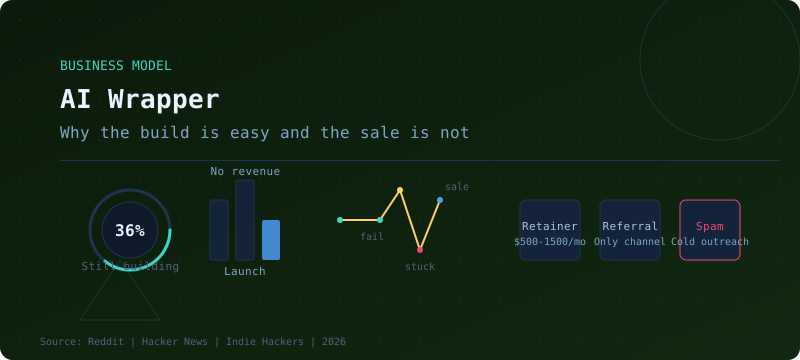
I spent the last week digging through Reddit, Hacker News, and Indie Hackers for one question: is the AI wrapper business model actually real, or is it just another pitch deck? What I found was a strange split. Everyone agrees building an AI wrapper is easier than ever. Almost no one agrees on whether selling one is actually worth it.
The pattern keeps showing up: founders ship fast, some get traction, many hit the same wall at the same place. It is not technical skill that separates the winners from the stalled projects. It is whether they already had a path to customers before they wrote the first line of code.
—
## 1. The $75K automation builder who never made a website
A former GTM freelancer posted the full breakdown on r/AI_Agents. One client asked him to fix lead follow-up. He quoted $2,500, built it over a weekend with Zapier and GPT, and cut first-response time from 14 hours to 3 minutes. That client told two other business owners. Within about a year he had 18 clients, $75K total, and a recurring retainer base worth roughly $11K from just two referrals.
He never built a portfolio site, never ran ads, never wrote a pricing page. His stack stayed minimal: automation tools and GPT. His pricing evolved from flat fees to build fees of $3K-$7K plus $500-$1,500 monthly retainers. The retainers were the turning point. Project work pays once. Retainers turn a freelancer into a partner.
His client list reads like a case study in boring high-value verticals: dental offices, HVAC companies, real estate teams, insurance brokers. His own summary was direct: don not sell AI. Sell the outcome. Not once has a client asked what model he is using.
The signal on this post was strong: 391 upvotes and 187 comments. People kept asking follow-up questions for months.
**Key numbers:** $75K total, 18 clients, $11K from two referral clients alone.
**What broke first:** Early pricing was flat-fee only, which capped income even when demand was good.
**Fix:** Switched to build fee plus monthly retainer after realizing one-time work did not scale.
**Smartest move:** Targeted local service businesses that do not comparison shop and just want the problem gone.
**Real lesson:** Distribution here was referral-driven, not outbound-driven. That matters more than the automation skill itself.
*Source: Reddit — “I made 75K selling AI automations to clients” (2026)*
—
## 2. The $0 experiment: 6 weeks, every strategy, zero return
Not every AI side hustle story ends in revenue. One Reddit post from a corporate professional became one of the most honest breakdowns of the AI money trap. Over six weeks they tried a WordPress blog, a Ghost blog, four Fiverr gigs, and multiple AI service ideas. Total cost: $50 for ChatGPT Plus, $20 for Ghost hosting, and six weeks of focused time. Total return: $0.
The failure diagnosis was blunt. Every idea collapsed under the same question: who is actually paying, why would they pay someone cold-contacting them, what work already exists, and what cost is being replaced? The post argued that most people making money with AI fall into four categories: they already had an audience, they are selling to people who want to make money with AI, they would have earned the money anyway and AI gets the credit, or they are exaggerating.
The post got 307 upvotes and 185 comments. The discussion stayed practical rather than motivational. That is rare in AI side hustle threads.
**Key numbers:** $0 revenue after 6 weeks, $70 spent, multiple failed channels.
**What broke first:** Started with distribution channels before validating whether anyone wanted to pay for the outcome.
**Fix:** Realized the issue was not the tool or the idea; it was the absence of a buyer.
**Smartest move:** Shared the exact failure conditions instead of repositioning the experiment as a learning journey.
**Real lesson:** Building is cheap. Finding someone who will pay is not. The failure here was not AI; it was channel choice before demand validation.
*Source: Reddit — “AI side hustle honest experiment” (2026)*
—
## 3. The client acquisition desert: everyone selling, nobody buying
A second pattern appeared across multiple subreddits. Solo founders in r/n8n and r/automation described months of outreach with almost no real revenue. One founder tried cold email, Upwork, YouTube, X/Twitter, and Reddit. Another had an existing CRM and ERP business and was still skeptical that AI automation tools were attracting high-ticket clients. The diagnosis from comments was consistent: business owners are getting hit with AI spam from every direction, and generic automation pitches blend into the noise.
One playbook cut through the clutter. A founder built a customer service agent specifically for clinics, offered a free 2-month implementation, and asked for a monthly fee plus a video testimonial if it worked. The testimonial from a doctor became the sales asset. Five more clinics signed after that one recommendation.
The broader debate in r/indiehackers was whether speed to ship still matters when everyone can ship fast. Base44 was acquired by Wix for $80M as a one-person, six-month project. Cameron Trew hit $2K MRR in 90 days building Kleo with Claude Code. The worry was that if 50 people can ship the same idea in four weeks, competition becomes insane. The counterargument was that speed is table stakes now; depth of insight into a specific problem is the actual moat.
A less quoted detail from the Base44 founder: he said publicly that the exit still felt isolating. Tools handle execution. They do not replace the part where you need someone to push back on a bad assumption.
**Key numbers:** $0 after months of outreach in multiple channels; one clinic playbook produced 5 additional clients from one testimonial.
**What broke first:** Generalized outreach across too many channels with no social proof or niche positioning.
**Fix:** Narrowed to one vertical, removed upfront risk for the client, traded implementation cost for testimonial rights.
**Smartest move:** Used a doctor-to-doctor referral loop instead of cold outreach.
**Real lesson:** The bottleneck shifted from building to distribution. Speed helps, but only after you have a believable path to customers.
*Source: Reddit — “Client acquisition desert” threads in r/n8n, r/automation, r/indiehackers (2025-2026)*
—
## 4. The $1.4K SaaS from a Fiverr lyric-video side gig
A different angle showed up on Indie Hackers. Alejandro found Fiverr gigs charging $50-$250 for lyric videos. Instead of competing on price, he built a small SaaS around the workflow. Three months later he had 1,335 registered users and 16 paying subscriptions, with $1,410 in revenue.
This is not quit-your-job money. It is also not a failure. The pattern is the same as the bigger stories: find a real workflow people already pay for, then productize it. The difference is scale. Lyric videos are a narrower market than dental lead follow-up or YouTube automation, so the ceiling is lower.
His takeaway was that the SaaS was never about the technology. It was about converting a manual service people were already buying into something repeatable and scalable.
**Key numbers:** $1,410 in 3 months, 1,335 registered users, 16 paid subscriptions.
**What broke first:** The market was small and price-sensitive.
**Fix:** Accepted the niche size instead of forcing growth into unrelated verticals.
**Smartest move:** Started from an existing paid workflow instead of inventing a new problem to solve.
**Real lesson:** Not every wrapper needs to become a $30K MRR business. Some are legitimately small, and that is okay if the expectation is set correctly.
*Source: Indie Hackers — “People charge $200 on Fiverr for lyric videos…” (2026)*
—
## Common patterns
**1. Building is the easy part now**
Every story confirms this. The $75K automation builder used Zapier and GPT. The Fiverr wrapper was built quickly. Base44 shipped in six months alone. The bottleneck is not code anymore.
**2. Distribution is the new moat**
Referrals, testimonials, and existing audiences are what turned builds into income. Cold outreach and Fiverr competition produced the $0 result and the stalled SaaS.
**3. Domain expertise beats AI proficiency**
The founders making money are not the ones who know the most about GPT variants. They know dental offices, HVAC companies, Amazon sellers, or lyric-video buyers.
**4. Retainers change the economics**
One-time projects create freelancers. Recurring retainers create businesses. The $75K story only became stable after retainers replaced flat fees.
**5. The numbers are real but take work**
There is no $100K-in-a-weekend story here. There is also no universal failure. The outcomes vary by vertical, channel, and whether the founder had distribution before the product.
—
• Reddit — “I made 75K selling AI automations to clients”
• Reddit — “AI side hustle honest experiment”
• Reddit — “Client acquisition desert” threads in r/n8n, r/automation, r/indiehackers
• Indie Hackers — “People charge $200 on Fiverr for lyric videos…”