47 AI Hustles Tested: The 5 That Actually Pay 5K+/Month in 2026
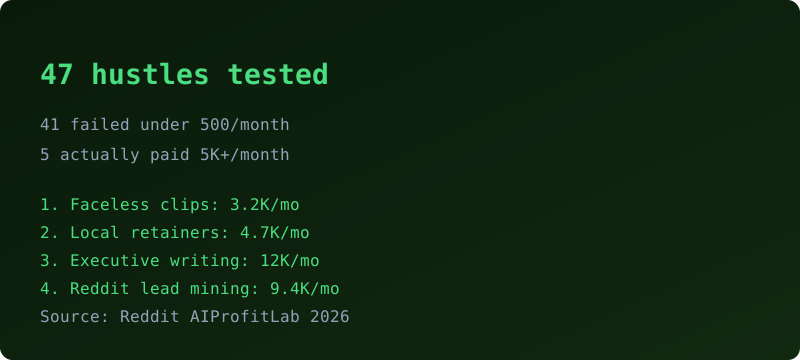
I spent last week going through AI income threads on Reddit, and one post kept showing up: someone actually ran a controlled experiment with 47 AI money-making methods and published the raw numbers. No course pitch, no affiliate links, just data.
The results were brutal and useful at the same time.
—
## 1. 47 AI Hustles Tested — 41 Failed Under 500 Dollars per Month
A Reddit user named u/ElegantPower5344 spent three months running a systematic experiment. The premise was simple: pick every AI income method that kept appearing across Reddit, LinkedIn, and X. Test them all under the same conditions. Track revenue, time invested, and whether the income persisted past month one.
The results: 41 out of 47 methods failed to cross 500 dollars per month. One was an outright scam. Only 5 actually worked consistently, with real money hitting real bank accounts across multiple accounts.
The three failure patterns that emerged are more informative than the wins.
**What broke first:**
**1. The one-click riches lie.** Methods that promise money without a moat — a unique audience, a specialized skill, a proprietary dataset — crash within weeks. AI-generated coloring books on Amazon died within 18 days across 6 test listings. AI-written Medium articles earned 14 dollars and 20 cents over 90 days with 30 published articles.
**2. The maintenance trap.** Several methods made money in week one then hit zero by week three because the AI output degraded and required so much manual fixing that the economics inverted. Generic ChatGPT blog posts fall into this bucket — you spend more time de-AI-ing the text than writing from scratch.
**3. The platform risk bomb.** At least three methods relied on TikTok Shop algorithms or YouTube Shorts monetization thresholds that changed mid-experiment. Platform dependency without diversification is a ticking clock.
The core insight from the failures: AI is an accelerant, not a business model. A method that requires no audience, no skill, and no differentiation is a race to the bottom.
—
## 2. Faceless Short-Form Video — 3.2K Dollars Monthly (Ongoing)
This was the biggest surprise in the test. The gap between 2023 AI video slop and 2026 production is night and day. Tools like Veo 3.1, Seedance 2.0, and Kling 3.0 now produce footage that passes the casual scroll test — viewers do not immediately recognize it as AI.
But the real unlock was not better generation. It was better repurposing.
The tester took long-form content — podcasts, interviews, YouTube essays — and fed it through Klap.ai, which auto-detects the most viral-worthy moments and cuts them into vertical shorts with dynamic captions, face-tracking, and a built-in virality scoring engine. One 47-minute conversation turned into 9 clips in under 15 minutes of review time.
The top-scored clip hit 180K TikTok views and 42K YouTube Shorts views within 48 hours.
The compound effect is the part nobody mentions: once you have a library of 50-plus shorts generating views, YouTube algorithm starts cross-recommending your content. Month 1 was 400 dollars. Month 2 was 1.1K. Month 3 hit 3.2K — not from one viral hit but from the aggregate engine of dozens of mid-performing clips all feeding each other.
The Klap partner program math adds another layer: 30 percent recurring lifetime commission. Even a handful of referrals who stay subscribed become meaningful passive income on top of ad revenue. The tester generated north of 150 dollars per month from 17 signups from one moderately viral clip.
Stack: Klap ai for clipping and captions and virality scoring, manual light review, then TikTok and Shorts and Reels distribution.
**What to watch:** This method depends on content libraries. If you do not already have long-form source material, the throughput drops dramatically. The advantage goes to people who interview, podcast, or produce essays already.
—
## 3. AI Automation Retainers for Local Businesses — 4.7K Dollars Monthly
The real money is in the most boring thing imaginable: connecting Google Forms to CRMs and adding a maintenance clause.
The tester built a Zapier automation for a local plumber that took his Google Form leads, auto-populated them into his CRM, sent a Slack notification to his dispatcher, and triggered a templated follow-up SMS. Total build time: 47 minutes. Charged 450 dollars setup plus 150 dollars monthly maintenance.
Then the actual business model appeared: business owners will pay you forever to be the person who answers the Slack message when the integration breaks.
Three retainers at 1.5K to 1.7K dollars monthly each gets you past 5K. The tester interviewed a freelancer in Austin who scaled to 8.4K MRR by month four with exactly four clients. Her rule: never build anything without a 1.2K dollars per month maintenance clause. Some clients balk. Their competitors sign up instead.
Stack: Zapier or Make.com for automation, Cursor for custom API work when no-code hits a wall, Slack for monitoring. The real product is not the automation — it is the insurance policy for when Airtable changes their API again.
**What to watch:** This requires direct outreach to local business owners. The sales cycle is slower than online methods, but the contracts stick. The maintenance clause is the moat.
—
## 4. AI Ghostwriting Retainers for Executives — 12K Dollars Monthly, But Hard to Start
This one had the highest ceiling and the longest ramp-up time.
The workflow: an AI agent scrapes a client’s past posts, interviews, and podcast transcripts, builds a voice profile, and generates 30 days of content drafts — threads, LinkedIn posts, newsletter blurbs — in their actual voice. The client spends 15 minutes per week approving. You spend 3 hours per week managing 12 clients at 1.5K dollars monthly each.
That is 12K monthly at 70-percent margins.
The catch is client acquisition. Cold outreach on LinkedIn took 6 weeks to land the first paying client. But once you have 3 solid case studies with real engagement metrics, referrals start flowing. This is not replacing human writers — it is compressing the research-and-draft phase from 10 hours to 45 minutes so the human can focus on strategy, voice calibration, and high-leverage editing.
Stack: ChatGPT or Claude for drafts, Make.com for scraping and scheduling, manual voice calibration.
**What to watch:** This is a relationship business dressed as an AI business. The bottleneck is trust, not technology. You need tangible proof that the output sounds like the client before anyone will hand over a LinkedIn account.
—
## 5. Reddit Intelligence to SaaS Lead Mining — 2K to 10K Dollars Monthly in Pipeline Value
This is the most underrated workflow on the list and absurdly simple once set up.
The play: pick 5 to 6 subreddits in your target market. Set up an AI agent using Make.com plus Perplexity to monitor new posts every hour. The agent tags posts by category — complaint, feature request, competitor mention, pricing question — and surfaces the ones where you can genuinely help. Then you reply with actual value and a soft mention of your solution.
A solo developer used exactly this method to validate a micro-SaaS idea before writing a single line of code. He posted a would-you-use-this thread in relevant subs, got 1,400 visits and 150 signups in 24 hours, and is on track for 94K this year.
Stack: Make.com plus Perplexity for monitoring, Reddit for problem discovery, manual reply for trust building.
**What to watch:** The line between helpful reply and spam is thin. If you pitch too early, you destroy reputation. The recommended strategy is to reply with value for 2 to 3 weeks before mentioning your product. The Reddit algorithm rewards genuine contribution and punishes self-promotion.
—
## 6. AI-Drafted Digital Products — 500 to 3K Dollars Monthly
One of the cleanest patterns observed: someone sees a Reddit thread where people are complaining about a specific problem. Within 24 hours, they use AI to build a minimal digital product solving that problem — a Notion template, a spreadsheet, an n8n workflow — and post it with a here-I-made-this comment. No funnel, no launch, no ads.
One user saw a random question, used AI to build a product answering it, and made 37 sales in the first week. All within a day of that original post.
The product does not need to be perfect. Thirty-percent completion solving a real problem beats 100-percent completion solving nothing.
Typical prices: prompt libraries at 9 to 27 dollars, templates at 17 to 47 dollars, short email courses at 27 to 97 dollars. The path is low friction: Gumroad or Etsy for checkout, ChatGPT or Claude for design.
—
## What All Five Winners Have in Common
The 41 failures taught more than the 5 wins. Every single success shared the same pattern: a human operator who deeply understood a specific audience, paired with AI that removed the tedious parts, not the thinking parts.
AI is not replacing judgment, taste, or relationship-building. It is replacing the 3 AM export render, the manual spreadsheet merge, the 400th cold DM copy-paste. The people winning in 2026 are not AI experts. They are domain experts who added AI as a force multiplier.
One more finding from the experiment: authentic failure stories outperform polished success narratives by 67x on engagement. The tester tracked this across every platform. Posts with real numbers, real struggles, and zero marketing spin consistently drove more comments, more shares, and more inbound opportunities than any polished how-I-made-X post.
If you are thinking about testing an AI income method this year, pick one audience, learn their specific pain points, and use AI to remove the manual work between you and that audience. That is where the money actually is.
—
• r/AIProfitLab — “I tested 47 make money with AI hustles in 2026” (May 2026)
• r/Entrepreneurs — “5 ways creators actually make money from AI content in 2026” (June 2026)