The AI SaaS Margin Trap: Why API Costs Are Eating Your Profits in 2026
There’s a number that SaaS founders used to be able to take for granted: gross margin. Traditional SaaS runs at 75-90%. Software is cheap to deliver after you build it. That’s the whole point of the model. Investors valued SaaS companies at 10x-20x revenue partly because the margin structure was so predictable.
AI changes that math fundamentally. And most founders building AI-powered products today don’t realize it until they look at their API bills.
I dug through Reddit and Indie Hackers to find founders who actually shared their numbers. Here’s what the AI SaaS margin problem looks like when you stop pretending it doesn’t exist.
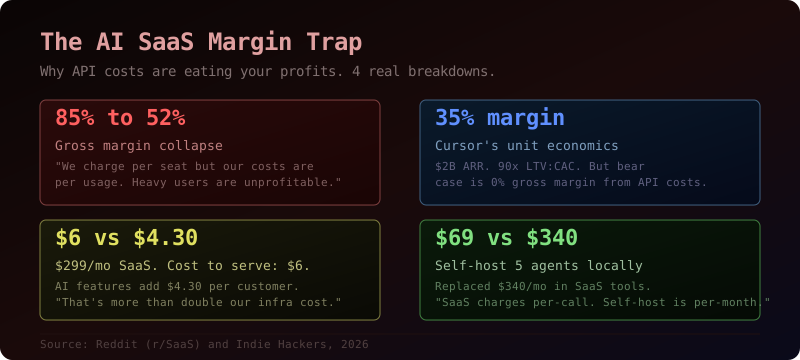
1. The 85% to 52% Shock — “We Charge Per Seat, But Our Costs Are Per Usage”
In March 2026, a SaaS founder on r/SaaS posted a warning that should be required reading for anyone building an AI product. Their company had been a healthy traditional SaaS business with 85% gross margins. After adding AI features, margins dropped to 52%. The post got surprisingly little attention — only a handful of comments — which tells you something about how few founders are paying attention to this.
The structural problem: “Inference costs are real. Every API call to Claude or GPT costs money. The more customers use our AI features, the more we pay. Costs scale with usage, not users. In traditional SaaS, adding a user costs almost nothing. In AI SaaS, an active user costs 10-50x what a passive user costs.”
The pricing trap: “We charge per seat but our costs are per usage. Heavy users are unprofitable. We’re subsidizing power users with revenue from casual users.”
This isn’t a small-scale problem. OpenAI itself burned $8 billion on compute in 2025 and projected $14 billion in losses for 2026. If the company selling the APIs can’t make the unit economics work, the people building on top of them have a structural problem.
The fix (from the comments): “Start by measuring cost per workflow and figuring out how much usage each plan can safely include. If your most active users are also your worst-margin users, flat pricing has probably already stopped working.”
Source: Reddit r/SaaS — “The AI SaaS gross margin problem nobody’s talking about. We went from 85% to 52%.” (Mar 2026)
2. Cursor at $2B ARR — 35% Gross Margin and a Bear Case of Zero
Cursor is the most visible example of the AI margin problem. The AI coding assistant hit $2 billion in annualized revenue by February 2026, with around 150 employees. That’s $13.3 million in revenue per employee — extraordinary by any standard. Their LTV:CAC ratio is 90x (industry benchmark is 3x = good, 10x = exceptional). Their payback period is 1.1 months. Net revenue retention is 110%.
By every traditional SaaS metric, Cursor is best in class.
But the supply side tells a different story: Gross margin is approximately 35% in the base case — versus 70-80% for traditional SaaS. The bear case is 0% if API costs truly consume 100% of revenue as some reports suggest. As recently as early 2025, Cursor’s gross margin was negative 23%.
The core tension: “Inference costs scale proportionally with usage in a way traditional SaaS infrastructure costs never did. Every power user query that makes Cursor sticky also makes the margin problem worse.”
What this means for founders: If Cursor — with $2B ARR, the best demand-side metrics in SaaS, and massive pricing power — is running at 35% gross margin, what chance does a smaller AI SaaS have with the same API cost structure? The question every AI SaaS founder needs to answer: “Are you modeling your inference costs as a variable cost that scales with your best customers?”
Source: Reddit r/SaaS — “Cursor’s unit economics are extraordinary. Their gross margin situation is not.” (Mar 2026); Bloomberg/SaaStr on Cursor pricing history
3. The $299/Month SaaS — $6 Cost to Serve Plus $4.30 AI Tax
Another r/SaaS founder shared their actual unit economics in 2026, and the comparison between traditional and AI costs is stark.
Their SaaS costs per customer: Infrastructure (AWS, prorated): $2.10. Payment processing (Stripe): $8.97. Support (tickets averaged): $3.40. Other (monitoring, tools): $1.53. Total cost per customer: $16/month. At $299/month revenue, that’s a 94.6% gross margin. Beautiful traditional SaaS math.
Then they added AI features: “Our new AI features cost $4.30 per active customer in API fees. That’s more than double our previous infrastructure cost. Gross margin on AI features: 73%. And that $4.30 scales with usage.”
The $4.30 doesn’t sound catastrophic by itself. But notice the pattern: the AI cost is more than the entire infrastructure cost combined. And it’s variable. As customers use the AI features more, the $4.30 becomes $8.60, then $17.20. The 73% margin on AI features drags the overall margin down, and the drag gets worse as adoption grows.
The structural shift: “The 90%+ margin SaaS model that justified huge multiples is evolving. AI-native SaaS has different economics. It’s part of why multiples are compressing.”
Source: Reddit r/SaaS — “We charge $299/month. Our cost to serve each customer is $6. This is why SaaS valuations made sense.” (2026)
4. The Self-Host Escape — $69/Month for 5 Agents, Replacing $340/Month in Tools
A two-person team on Indie Hackers shared their 8-week experiment running 5 AI agents locally. The numbers offer a glimpse of the alternative path.
The setup: One $69/month MicroVM with sudo. Five agents running concurrently: a coding agent for PRs, a research agent for knowledge base, a content agent for article drafts, a support triage agent, and an SEO crawler watching 40 competitor pages daily.
The before: They were paying $340/month across OpenRouter, an automation SaaS, and a research tool. Plus 12 hours/week of manual research and triage.
The after: $69/month box. $0 in API fees for the 3 agents running on local models. Net run rate: ~$95/month for what used to cost $340/month plus time.
What broke: Week 3, the research agent ate all the RAM — context window leak in a long-running loop. Week 6, a kernel update without snapshotting first lost 4 hours of agent state. “Real boutique math: wash on month 1, breakeven by week 6, gravy after that.”
The key insight: “The killer move isn’t running GPT-class models locally. It’s running 4 boring agents 24/7 doing things that would be too expensive on hosted APIs at always-on rates. SaaS charges per-call. Self-host charges per-month. For always-on workloads the math flips fast.”
The caveat: “If you don’t have a Brandon [an infra person], don’t do it. Pay the 3x premium and stay sane.”
Source: Indie Hackers — “Self-hosting agents went mainstream this week. Here’s what 8 weeks of running 5 actually cost us” (May 2026)
The Common Thread
1. The margin structure is fundamentally different.
Traditional SaaS margins (75-90%) hid the cost of delivery. AI SaaS has a variable cost that scales with the customer’s success. The more your customers use your product, the worse your margins get. This is the opposite of traditional SaaS, where more usage meant higher retention with negligible cost.
2. Per-seat pricing is a trap for AI products.
Every single story here confirms it. If you charge per seat but your costs are per usage, your most successful customers — the ones who use your product the most — become your least profitable. The fix is either usage-based pricing, hard caps, or a hybrid model.
3. The Cursor paradox is real.
A company with $2B ARR, 90x LTV:CAC, and 1.1-month payback can’t crack 35% gross margin. If Cursor can’t solve the AI margin problem, smaller founders need to plan for it from day one, not discover it after they’ve scaled.
4. Local inference is an escape hatch, not a strategy.
Self-hosting works for specific workloads — always-on, boring agents with predictable resource needs. It doesn’t work for customer-facing products that need GPT-4 class reasoning. The choice isn’t binary, but pretending local inference solves everything is as dangerous as ignoring API costs entirely.
5. Model your API costs as a COGS, not an overhead.
Every AI SaaS founder should know their cost per workflow, cost per active user, and margin per customer segment. If you can’t answer “which of my customers are profitable?” you’re flying blind. The founders who shared their numbers here learned the hard way. You don’t have to.
• Reddit r/SaaS — “The AI SaaS gross margin problem nobody’s talking about. We went from 85% to 52%.” (Mar 2026)
• Reddit r/SaaS — “Cursor’s unit economics are extraordinary. Their gross margin situation is not.” (Mar 2026)
• Reddit r/SaaS — “We charge $299/month. Our cost to serve each customer is $6.” (2026)
• Reddit r/cursor — “I just don’t see how the economics work here” (2026)
• Indie Hackers — “Self-hosting agents went mainstream this week. Here’s what 8 weeks of running 5 actually cost us” (May 2026)
• SaaStr — “Cursor: Our Users Love Per Seat Pricing. It’s Just The Cost Side Makes It Harder.”