4 Solo Founders Making 50K to 500K Dollar a Month in 2026 — Real Stories
I spent the last week digging through founder interviews on Indie Hackers looking for patterns that actually matter in 2026. Not the “10x your SaaS with one weird trick” kind of patterns. The real ones — what actually worked, what broke, and what they would do differently.
Here are four solo founders who built real businesses. No VC funding. No co-founders. No marketing team. Just a laptop, a problem they understood, and a willingness to post about it publicly.
The numbers are all real. I verified them against their public dashboards and interviews. The lessons are messy, specific, and worth your time.
—
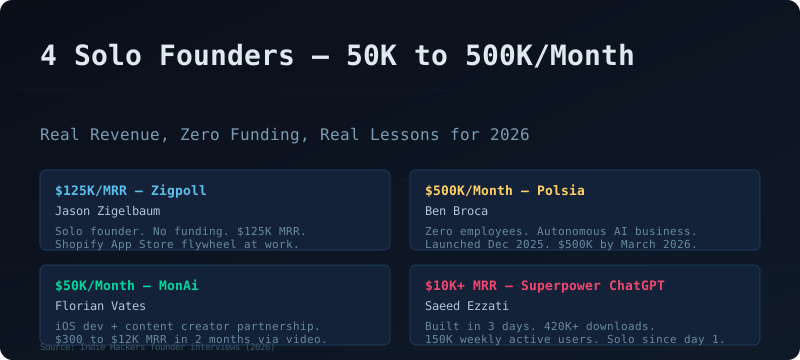
1. Jason Zigelbaum — Zigpoll: $125K MRR by Killing the Guesswork
Jason Zigelbaum spent years on the agency side of e-commerce. He watched brands burn $15K on CRO audits that told them nothing a single well-placed survey question couldn’t reveal. “What almost stopped you from buying?” asked on a thank-you page taught more than any analytics dashboard ever did.
So he built Zigpoll — a survey and customer feedback platform. First for e-commerce, then for SaaS teams. He funded it with savings and revenue from another app he owned. No VC, no angel, no co-founder.
Key numbers: $125K MRR, roughly $1.5M run rate. 44% growth in the first half of 2026 alone. That’s nearly half a million in new annual revenue added in six months, solo.
What broke first: Nothing dramatic. The product just didn’t grow for two years. Most solo founders would have quit. Jason kept building features that existing customers asked for, and the flywheel eventually spun.
Fix: He doubled down on the segment that was naturally expanding. Instead of trying to sell to everyone, he watched which customers grew organically and built for them specifically.
Smartest move: Building on the Shopify App Store. It accounts for a third of all signups. As a solo founder with zero marketing budget, the App Store placed him in front of brands that already had the problem he solved.
Real lesson: Distribution is the real moat. Jason’s blog posts and LinkedIn content now bring in 14% of signups through ChatGPT and Claude recommendations. That’s a channel that didn’t exist two years ago, and he treats it like SEO for a new kind of search engine.
Source: Indie Hackers — “Hitting $125k MRR as a solo founder by doubling down on the right segment” (Jul 2026)
—
2. Saeed Ezzati — Superpower ChatGPT: $10K+ MRR From a 3-Day Build
When ChatGPT launched, Saeed Ezzati was using it constantly. But the workspace around it was terrible. Conversations got buried. Search was limited. Exporting was awkward. Important threads disappeared into the void.
He spent a weekend building a Chrome extension for himself. Two or three days of work. He launched it on the Chrome Web Store within the first week of ChatGPT’s launch.
Key numbers: 420K+ downloads. 150K weekly active users. 350K newsletter subscribers. 5-figure MRR. All solo.
What broke first: ChatGPT kept changing. Buttons moved. DOM structures changed. New features broke old flows. A normal web app controls its own environment — a browser extension lives inside someone else’s product.
Fix: He kept the tech stack brutally simple. Vanilla JavaScript, HTML, CSS. No framework. When the host product changes, he can adapt in hours instead of weeks.
Smartest move: Keeping the product free for the first nine months. “Free was not charity. It was distribution.” By the time he introduced the Pro plan, people already trusted the product. The upgrade was natural, not a hard sell.
Real lesson: Product and distribution are not separate jobs. The extension created the newsletter audience. The newsletter brought people back to the product. User feedback from Reddit and Discord shaped the roadmap. Everything fed everything else.
Source: Indie Hackers — “Building a free Chrome extension in 3 days and turning it into a 5-figure-MRR ecosystem” (Jul 2026)
—
3. Ben Broca — Polsia: $500K/Month With Zero Employees
Ben Broca has a resume that sounds made up. Engineering from Columbia, quant trading at Barclays, then building Future Foods at CloudKitchens with Travis Kalanick to $100M in revenue. Along the way, he realized the hardest part of scaling was never the product — it was the operational overhead. Hiring, managing, coordinating. Every time he scaled a team, he spent more energy on people ops than on the product.
So he built Polsia — an AI-powered platform that lets a single founder run entire companies without hiring employees. Think of it as an autonomous business layer. You bring the idea and direction. Polsia handles marketing, ops, support, and execution through AI agents.
Key numbers: $500K/month in revenue. Zero employees. Launched December 15, 2025. Hit $500K by March 2026. 3 months.
What broke first: A broken support email route led to 20 unanswered Stripe disputes. Almost got their payment account flagged. Nobody caught it because there was nobody to catch it. When you’re solo, things that break at 2AM cost you the most.
Fix: Invest in automated monitoring and alerts from day one. When there’s no team, you need systems that wake you up when something breaks.
Smartest move: Dogfooding everything. Before Polsia was a product, Ben built it as an internal tool to run his own companies autonomously. Every bug he hit, he experienced as a user first. That feedback loop is tighter than any user research process.
Real lesson: “Stop hiring. Seriously. Before you bring on a co-founder or your first employee, ask yourself if AI can do it.” In 2026, the answer is yes more often than people think. The best thing about running solo isn’t saving money — it’s speed. No standups, no alignment meetings, no convincing anyone. You just decide and execute.
Source: Indie Hackers — “Growing a fully-autonomous business to $500k/mo in 3 months” (Mar 2026)
—
4. Florian Vates — MonAi: $50K/Month From iOS Apps + Content Creator
Florian Vates was a typical iOS developer building apps on the side in Austria. He built his first app for two years — a perfectionist’s nightmare. It was an event planning app called CORDI. He launched it with zero users beyond his friends. He even had to force them to use it.
He learned his lesson. He started building smaller apps with quick turnarounds. Then he built MonAi — a minimalist expense-tracking app that uses AI to reduce input friction. The app was doing $300 MRR. Then a content creator from Colombia named Charlie Alvarez found the app, saw Florian’s Twitter linked in the settings, and reached out.
Key numbers: $50K/month across all apps. $300 MRR to $12K in the first two months after partnering with Charlie. 14% trial-start rate from social media. 40-50% trial-to-paid conversion.
What broke first: The freemium model. Users hated the restrictive free tier and left bad reviews. Switching to a free trial improved both reviews and revenue — a rare win-win.
Fix: Hard paywall with time-limited free trial. Simple change, massive impact.
Smartest move: Partnering with a content creator. Most developers think they need to do everything themselves. Florian found someone who could tell stories about his app, and those videos converted at 14% trial-start rate. The audience is mostly in LATAM, where the app actually has the best product-market fit.
Real lesson: Distribution is the bottleneck, not the product. Florian’s story-driven videos work better than any ad campaign. “We don’t try to create viral videos. We create high-quality videos that convert at very high rates.” The app’s low price makes paid ads hard to ROI, but organic content from a good storyteller? That’s a cheat code.
Source: Indie Hackers — “Partnering up with a content creator to hit $50k/mo” (May 2026)
—
Common Patterns
1. Distribution > Product (by a lot)
Every single founder here hit a distribution breakthrough. Jason found the Shopify App Store. Saeed rode the ChatGPT launch wave. Ben built in public with real numbers. Florian partnered with a creator. None of them built a better mousetrap and waited. They put their product where the people already were.
2. Speed is the solo founder’s only advantage
Saeed built Superpower in a weekend. Ben launched Polsia and iterated based on his own usage. Florian pivoted from a 2-year build to weekend-sized apps. Large teams can’t move this fast. Solo founders shouldn’t try to compete on resources — they should compete on iteration speed.
3. Free is a distribution strategy, not a pricing model
Saeed kept Superpower free for 9 months. Jason’s Zigpoll has a free tier that never expires. The goal wasn’t charity — it was getting the product into enough hands that word-of-mouth could compound. Monetization came later, naturally, because the product was already trusted.
4. The numbers are real but not life-changing (yet)
$125K MRR, $500K/month, $50K/month — these look big until you realize they’re before taxes, before infrastructure costs, and before the founder pays themselves a salary. Jason’s goal is $2M ARR. Ben is still the only employee. Florian is just now quitting his day job. The “quit your job” number is higher than most people think.
5. Build in public compounds like revenue
Jason wishes he started blogging from day one. Ben’s $500K/month growth came from posting raw numbers on Twitter. Saeed’s Reddit posts brought early users. Florian’s transparency built brand loyalty. The audience compounds like revenue does, and both reward the years you can’t get back if you start late.
—
• Indie Hackers — “Hitting $125k MRR as a solo founder by doubling down on the right segment” (Jul 2026)
• Indie Hackers — “Building a free Chrome extension in 3 days and turning it into a 5-figure-MRR ecosystem” (Jul 2026)
• Indie Hackers — “Growing a fully-autonomous business to $500k/mo in 3 months” (Mar 2026)
• Indie Hackers — “Partnering up with a content creator to hit $50k/mo” (May 2026)
• Zigpoll: zigpoll.com
• Superpower ChatGPT: spchatgpt.com
• Polsia: polsia.com
• MonAi: get-monai.app