4 People Who Built Products With AI Coding Tools in 2026 — Real Revenue, Real Fails
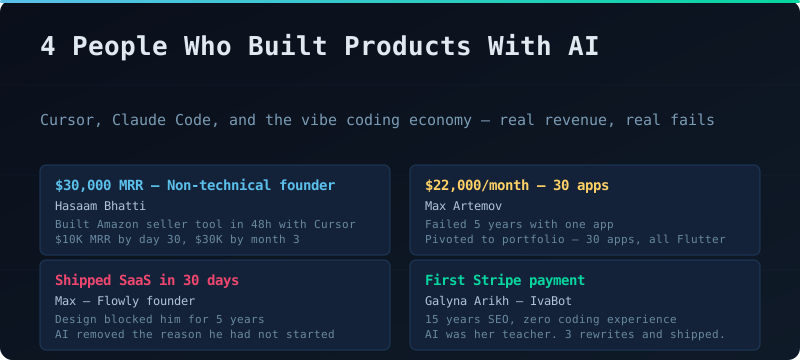
I spent a week digging through Indie Hackers, Reddit, and HN. Not looking for “vibe coding will replace all developers” takes. Looking for bank deposits. Screenshots. The raw numbers behind people who actually used AI coding tools — Cursor, Claude Code, Codex — to build something real and get paid.
The hype says everyone is building. The reality? Most vibe-coded apps die in a week. But these four people did something different. They shipped. They got users. They generated revenue. Here is what they built, what they earned, and what broke along the way.
1. Hasaam Bhatti — $30,000 MRR, no coding experience
Hasaam worked a corporate job and ran two Amazon brands on the side when he found Cursor on Twitter. No CS degree. Never wrote a line of code. He had tried building products before — AI video tools, job automation apps, ten or twelve of them. None made it to production because he was building for audiences he did not belong to.
Amazon was different. He spent 20 to 30 hours a week researching products, copy-pasting data into Google Sheets. He was frustrated, and he knew exactly what was broken. So he built the tool he needed.
He found a coaching program called Legacy X with thousands of active Amazon sellers. He pitched them: give me 48 hours to build the solution. If you like it, we partner. He built it in Cursor in 48 hours. They called the next morning and told him to quit his job.
Key numbers: $10,000 MRR on day 30. $17-18K by day 60. $21.8K by day 90. Now at $30,000 MRR. A Chrome extension with 330 active users. All built in Cursor by a guy who still cannot read a stack trace without AI help.
What broke first: The original stack — Cursor, Vercel, Supabase, Apify, Resend — worked for MVP but could not scale. Apify was fine for prototyping but too expensive and inflexible at $30K MRR. He rebuilt the data layer from scratch on Cloudflare.
Smartest move: Trading equity for distribution. Legacy X already had thousands of sellers looking for tools. That single partnership bypassed the hardest problem — getting first users — on day one.
Real lesson: Domain expertise beats technical skill every time. Hasaam knew Amazon selling inside out. Cursor just removed the “I cannot code” barrier. The product worked because he understood the problem, not because he knew TypeScript.
Source: Indie Hackers — “Building a product in 48 hours and hitting $30k MRR as a non-technical founder” (Jun 2026)
2. Max Artemov — $22,000/month from 30 apps
Max is an iOS developer with eight years of experience. He spent five years building a single calorie counter app. Tried everything — marketing, ASO, feature updates. Nothing worked. The app was dead in the water.
Then he found a YouTube video about building a mobile app portfolio instead of obsessing over one product. He changed his entire approach: build fast, ship fast, and focus on one core feature per app. In under a year, he built over 30 apps generating a combined $22K MRR.
Key numbers: $22,000 MRR across 30 apps. Flutter + Firebase stack. ASO-driven growth — keyword research happens before the app is even built. Finds a keyword with high popularity and low difficulty, builds an app around it, uses the keyword in the title and subtitle.
What broke first: His engineering mindset. He spent years polishing code, following SOLID principles, and maintaining perfect architecture. That approach slowed him down so much that he never got to validate whether anyone wanted the product. The shift from “perfect code” to “ship and iterate” was the turning point.
Smartest move: Letting the market decide. Most of his 30 apps fade to 10-50 downloads per week after launch. But the ones that survive get his full attention. He does not get emotionally attached to any single idea — he just builds, releases, and sees what sticks.
Real lesson: A portfolio of small bets outperforms one big bet you cannot let go of. Five years on one app was a mistake. Thirty apps in one year was the fix.
Source: Indie Hackers — “From failed app to 30-app portfolio making $22k/mo” (Dec 2025)
3. Max (Flowly) — Shipped a SaaS in 30 days when AI removed the 5-year blocker
A backend-first developer with six years of enterprise experience. He had ideas for years. The blocker was never code — it was design. He could architect systems, write clean TypeScript, ship reliable APIs. But he could not make anything look good. Hiring a designer for a product with unknown revenue felt like betting money he did not have.
AI-generated design changed the calculus. It gave him a starting point — not Dribbble-worthy, but good enough to validate. AI coding tools handled everything that kills solo projects: boilerplate, tests, repetitive CRUD. What would have taken him six months took one month. Six months was a bet he could not afford. One month was survivable.
He built Flowly — a workspace for freelancers with tasks, timers, and analytics. Paying users at $8-12/month. Live at flowly.run.
Key numbers: 2x-4x speed improvement depending on the task. Built in 30 days instead of the estimated 6 months. Live with paying users.
What broke first: Distribution. He is a developer — building feels natural. Marketing feels like guessing. He catches himself opening VS Code when he should be talking to users. Shipping code feels like progress. Posting on Reddit feels like gambling.
Smartest move: Building for himself first. He uses Flowly daily. That is either a great sign or a selection bias trap — he is still figuring that out. But it means he understands the pain point intimately.
Real lesson: AI did not make him faster. It removed the reason he had not started for five years. The design gap was the real bottleneck, not the coding.
Source: Indie Hackers — “I shipped a productivity SaaS in 30 days as a solo dev” (Apr 2026)
4. Galyna Arikh — Non-dev solo founder gets her first Stripe payment
Galyna is not a developer. She came in with 15 years of SEO experience, some project management skills, and a digital illustration hobby. She wanted to build an SEO tool that checks how ready a site is to be cited by AI search engines like ChatGPT and Perplexity.
She spent nine months building IvaBot. She rewrote the stack three times. She learned everything from scratch — backend, database, webhooks, authentication — using ChatGPT and Claude as her teachers. The first attempt was a Telegram chatbot. Ten people would have used it. The second was a Typebot chat embedded on Webflow. That phase taught her how to write prompts, structure logic, make HTTP requests, and parse JSON. The third attempt finally shipped.
Key numbers: Monthly running costs dropped from $200 to $40 when she switched from the no-code stack to Claude-built code. First paying customer two weeks after launch. Pay-as-you-go pricing from $5, no subscriptions. One blog post went slightly viral and drove the first Google Search Console clicks.
What broke first: The no-code stack. Webflow + Typebot + Memberstack + Stripe + Supabase + SerpDev + Make cost $200/month before a single sale. Unsustainable. Switching to a proper code stack with Claude cut costs by 5x.
Smartest move: Staying lean. No subscriptions, just pay-as-you-go at $5. She knew the pain of $50-300/month SEO tools and built something for solo founders and small businesses who could not afford enterprise pricing.
Real lesson: Domain expertise plus AI beats pure technical skill. Galyna had 15 years of SEO knowledge. She did not need to be a great developer — she needed to be a great SEO who could use AI to build. That is a very different bar to clear.
Source: Indie Hackers — “I’m a solo founder. It took me 9 months and 3 stack rewrites to ship my SaaS” (May 2026)
Common Patterns
1. Domain expertise is the real moat
None of these four were technical prodigies. Hasaam knew Amazon. Galyna knew SEO. The Flowly founder knew developer tools. Max knew mobile apps. They used AI to remove the building bottleneck, not to compensate for not knowing their market.
2. Distribution is the new bottleneck
Building is cheap now. Getting anyone to see what you built is still brutally expensive. Hasaam traded equity for distribution. Max used ASO. The Flowly founder is still struggling with it. Every story confirms: the hard part is not the code anymore.
3. Speed changes the risk equation
A six-month build is a terrifying bet. A one-month build is survivable. A 48-hour build is a no-brainer. AI did not just make these founders faster — it changed what they were willing to try.
4. The numbers are real but modest
$30K MRR. $22K MRR. First Stripe payment. None of these are “quit your job and buy a Lamborghini” numbers. But they are real. They are growing. And they came from people who just started building instead of reading another “how to vibe code” thread.
5. Stack rewrites are the hidden tax
Every single person in this article rewrote their stack at least once. The no-code stack was too expensive. The MVP stack did not scale. The first architecture was wrong. Planning for a rewrite from the start is cheaper than pretending you will get it right the first time.
• Indie Hackers — “Building a product in 48 hours and hitting $30k MRR as a non-technical founder” (Jun 2026)
• Indie Hackers — “From failed app to 30-app portfolio making $22k/mo” (Dec 2025)
• Indie Hackers — “I shipped a productivity SaaS in 30 days as a solo dev” (Apr 2026)
• Indie Hackers — “I’m a solo founder. It took me 9 months and 3 stack rewrites to ship my SaaS” (May 2026)