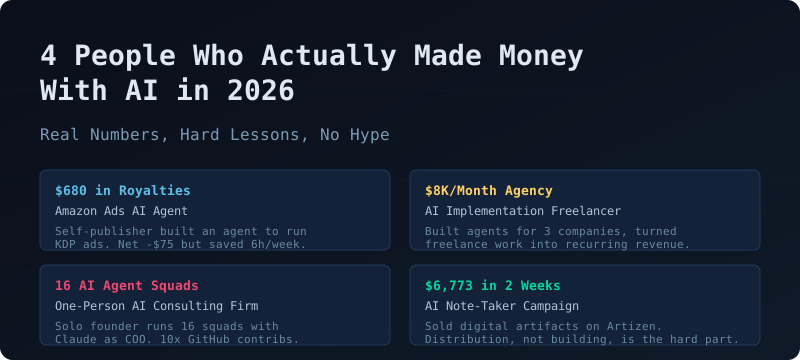
4 People Who Actually Made Money With AI in 2026 — Real Numbers, Hard Lessons
I spent a week digging through Indie Hackers, Hacker News, and Reddit. Not looking for
“AI will change everything” takes. Looking for receipts. Bank statements. Screenshots.
The messy, honest, “this didn’t quite work but here’s what I learned” posts.
Found four people who actually put money in their pocket using AI in 2026. None of them
got rich. All of them learned something you can steal.
—
1. The Amazon Ads Agent — $680 in Royalties, $757 in Ad Spend
A self-publisher on Indie Hackers (username Danonino80) runs a small KDP side business.
Ten books on Amazon. Managing ads was eating 6 hours a week. He was losing money
doing it himself.
So in May 2026, he built an AI agent on top of Claude and handed it the keys. The agent
runs every 3 days — pulls reports from the Amazon Ads API, adjusts bids, kills keywords,
creates campaigns. He just gets a report.
June numbers: ~$680 in royalties, ~$757 in ad spend. Net: -$75.
Not great. But before the agent, he was losing more and doing all the work. “I count it as
progress lol,” he wrote.
What broke first: The agent found his winning keywords and “helpfully” duplicated them
into a new campaign with higher bids. It started outbidding itself in the same auctions.
His main campaign went completely silent for 2 days before he figured it out.
Fix: A hard rule — every live keyword must be checked before creating anything new.
Duplicates can only bid 80% of the original.
Second lesson: Amazon attribution takes ~3 days to consolidate. If the agent judges
the last 48 hours of data, it kills keywords that were actually converting — the sales just
hadn’t shown up yet. He now excludes the last 2 days from every cut decision.
Smartest move: He stopped putting rules in the prompt. Everything lives in a YAML file.
Monthly cap, max bid change per cycle, max new campaigns per 72 hours. The agent reads
it before every action. When he wants to change something, he edits the YAML, not the
prompt. Every action goes to an append-only JSONL log.
The real lesson: “The ads were never the real problem. The agent optimized its way to
breakeven and then plateaued. No amount of bid optimization fixes a product page that
doesn’t convert.”
He’s now shifting the agent toward price experiments (with auto-revert rules) and listing
improvements (agent drafts, he approves).
Source: Indie Hackers — “I let an AI agent run my amazon ads for 2 months, sharing the real numbers” (July 2026)
—
2. The AI Implementation Freelancer — From $0 to $8K/Month Retainer
A freelance developer (username j0x on Indie Hackers) spent a year building custom AI
agents for three companies. A crypto startup. An AI infrastructure company. An enterprise
SaaS business.
The pattern was the same every time: the teams were already doing the work. They were
just losing hours to handoffs between tools, manual research, repetitive tasks, meetings
that should have been automated updates.
He’d come in, find the friction, build the integration, ship the agent. The team would go
from drowning to cruising. Metrics improved. Everyone happy.
Then he’d leave. And the knowledge would evaporate.
The next company would hire him to build something similar. He’d start from scratch.
Same problems, different logos. The work didn’t compound.
The pivot: He started Attiteud. Not as an agency — as a data company that uses
implementation as its acquisition strategy. The pitch: $8,000/month. Full coverage.
Less than a senior hire. Unsubscribe anytime after the initial deployment.
The key insight: every deployment gets captured into structured operational intelligence.
The decision trees, integration patterns, edge cases, outcomes. The next client benefits
from what was learned before. That’s the flywheel.
The honest part: He’s solo. No team. No entity revenue yet (the three engagements
were freelance, not agency). He’s building the capture system as we speak. Pre-seed.
Pre-everything.
Source: Indie Hackers — “I spent a year building AI agents for 3 companies. Here’s what I learned.” (June 2026)
—
3. The One-Person AI COO — 16 Agent Squads, 6 Parallel Sessions
A solo founder on Hacker News (koke_vidaurre) is running a one-person AI consulting
startup with Claude as his COO. “Not a metaphor — it actually runs operations.”
Every morning, agent squads execute: research competitors, draft content, monitor costs,
update memory. He makes decisions, Claude executes them across 16 domain squads.
The setup:
- 10 Claude Code sessions running in parallel
- 16 squads (marketing, engineering, finance, customer, etc.)
- ~100 agent definitions, all markdown files
- Shared memory via Postgres, session coordination via Redis
- Squads dashboard shows what’s running, what it cost, what changed
The result: GitHub contributions are up 10x since switching to this setup. Not because
he’s working harder — because the COO handles the grunt work while he focuses on
decisions.
Why this matters: He’s dogfooding. If he’s going to sell AI agent implementations to
clients, he should run on them himself. Every pain point, every failure mode — that’s
consulting IP.
First consulting clients are in the pipeline. He’s transparent that this is pre-revenue on
the consulting side, but the infrastructure is real and running.
Source: Hacker News — “I’m running a one-person AI consulting startup with Claude Code as my COO” (January 2026)
—
4. The AI Note-Taker Campaign — $6,773 in 2 Weeks
A solo builder (tommat23 on Indie Hackers) created MindNote, an AI note-taking app.
Instead of a traditional launch, he ran a campaign on Artizen — a platform where supporters
purchase digital artifacts rather than making donations.
In two weeks, he sold $6,773 worth of digital artifacts. Plus, Artizen matched
contributions at 2x or 3x depending on the milestone.
What actually worked:
- Starting with friends and family for momentum and social proof
- Posting consistently — milestones, progress, screenshots, ugly parts, lessons learned
- Supporting other founders’ campaigns (backing them, commenting on their posts)
- Personalized DMs and emails (converted much better than generic posts)
- Creating urgency with “50% funded” or “3 days left” updates
- Thanking every supporter publicly — gratitude creates momentum
The biggest lesson: “Building the product was easier than finding people willing to
support it.”
If he could start over, he’d spend weeks or months building a community before launching.
Collect emails with a landing page. Build a WhatsApp or Telegram group of early supporters.
Share the journey publicly while building. Find early users who genuinely love the product.
Ask people ahead of time if they’d support the campaign on launch day.
“Having a community before launching would probably make the campaign 10x-100x more
successful.”
Source: Indie Hackers — “I sold $6,773 in 2 weeks, with almost no existing community.” (June 2026)
—
What These 4 Stories Actually Tell Us
1. AI is an accelerator, not a business model.
None of these people built a “business around AI.” They used AI to do something
faster — manage ads, implement integrations, run operations, find supporters. The
AI was the tool, not the product.
2. The bottleneck moved from building to distribution.
Every single story confirms this. The Amazon guy plateaued because his product page
didn’t convert. The implementation guy’s challenge is finding clients, not building agents.
The AI COO’s pipeline is the constraint. The note-taker’s biggest insight was “build the
audience first.”
3. Guardrails matter more than prompts.
The Amazon agent outbid itself. The fix was YAML-based rules, not better prompt
engineering. The AI COO’s entire system is built on structured markdown definitions
and shared memory. The implementation guy’s capture system is about structured data,
not chat logs.
4. The numbers are real but small.
None of these are “quit your job” stories. -$75 on Amazon ads. A retainer model that’s
pre-revenue. An AI consulting firm that’s still building pipeline. $6,773 in a campaign
that hasn’t converted to product revenue. This is the honest picture of AI money in 2026:
It works. But it’s work.
• Indie Hackers — “I let an AI agent run my amazon ads for 2 months, sharing the real numbers (they’re not great)” by Danonino80 (July 2026)
• Indie Hackers — “I spent a year building AI agents for 3 companies. Here’s what I learned and why I started Attiteud.” by j0x (June 2026)
• Hacker News — “I’m running a one-person AI consulting startup with Claude Code as my COO” by koke_vidaurre (January 2026)
• Indie Hackers — “I sold $6,773 in 2 weeks, with almost no existing community.” by tommat23 (June 2026)