3 Solo Founders Who Hit 6-Figure ARR in 2026 — Zero Funding, Real Numbers
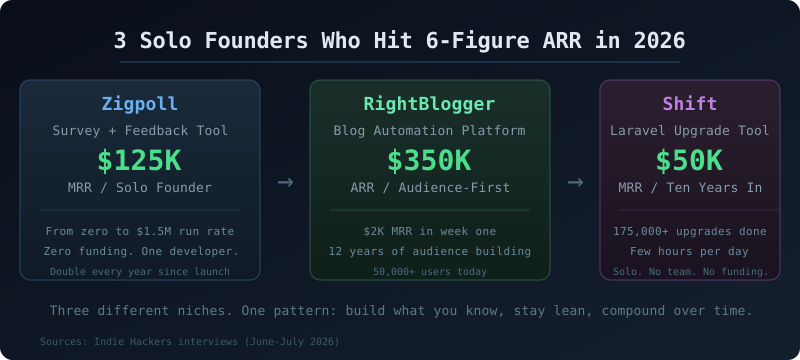
I spent a few days digging through Indie Hackers interviews from the last few weeks. Three stories stood out — not because they raised millions or hired fast, but because they did the exact opposite. Each founder built a profitable software business alone, without funding, and hit real revenue numbers you can actually verify.
No fluff. No “I’m building in public” threads with zero revenue. Just three people who shipped something, kept going, and now have the kind of monthly numbers most founders dream about.
1. Zigpoll — $125K MRR, Solo, and Still Growing 44% Per Half-Year
Jason Zigelbaum runs Zigpoll, a survey and feedback platform for e-commerce and SaaS teams. He’s the only employee. No co-founder, no sales team, no investors. Started 2026 at $1.03M ARR and is closing June at roughly $1.5M run rate. That’s nearly half a million dollars of new annual revenue added in six months, all by himself.
The backstory: Jason spent years on the agency side of e-commerce. He watched brands spend thousands on ads and analytics tools that told them what happened but never why. Analytics could show a cart was abandoned. It couldn’t tell you why. That gap nagged at him until he built the tool he wished existed.
The result is Zigpoll — a tool that puts a single question on a thank-you page (“What almost stopped you from buying?”) and captures answers at the exact moment customers will tell the truth. One question like that, he says, “can teach more than a $15K CRO audit, and it does so for free, forever.”
How he funded it: Jason built the first version himself with a code editor, not a budget. He funded the build with savings and revenue from another app that required only a few hours per week. No VC, no angel, no co-founder. “When you’re a solo developer, your main cost is the income you’re not earning while you build,” he says.
Growth pattern: It took two years to get traction. Then it doubled every year since. The key moment? He noticed which customers naturally expanded and deliberately built for them. “Find the segment that grows when you serve them well, and pour your energy there.”
The tech stack: JavaScript (Express + Mongo backend, React frontend), Redis for caching. Nothing fancy. He leans on reliable third-party tools to save time.
What you can steal from this: Domain expertise is an unfair advantage. Jason’s agency background meant he’d already watched dozens of e-commerce brands hit the same wall. He didn’t guess at the problem — he’d lived it for years.
Source: Indie Hackers — “Hitting $125k MRR as a solo founder by doubling down on the right segment” (July 2026)
2. RightBlogger — $350K ARR, Audience-First, Built in a Weekend
Ryan Robinson built an audience for 12 years before launching RightBlogger, a blog automation platform for marketing agencies and content teams. When he finally shipped, he had $2K MRR within the first week. Today, he’s at $350K ARR with 50,000+ users.
The backstory: Ryan runs a blog about blogging and SEO that reaches 500,000 monthly readers. He also runs a YouTube channel with 80K+ subscribers and a boutique content agency. For years, his audience kept asking him the same question: “What AI writing tool should I use?”
He didn’t have a good answer. The tools he’d recommend were a patchwork of five or six subscriptions that cost more than most lean teams could afford — and none of them was built with a real workflow in mind.
In 2023, when AI burst onto the scene, he and his business partner Andy Feliciotti decided to build the tool they’d wished existed. Andy built the MVP in a weekend using a SaaS boilerplate and OpenAI’s API. “He builds, I sell,” Ryan says.
The unfair advantage: Ryan had a built-in audience of 300,000+ email subscribers. He could teach a new toolset to them the same day they shipped and know within hours whether it would work. Most founders would kill for that feedback loop.
Growth pattern: They started with 25 tools (blog idea generator, outline tool, article writer). They kept adding tools based on what users asked for. Now they’re at 80+ tools. “The product grew the way a blog grows — one piece at a time, each answering a real challenge someone had.”
Key insight: They built a model-agnostic layer so they can swap AI providers (Anthropic, OpenAI, Gemini) without breaking the product. “If you’re building in AI and you’ve hard-coded yourself into one vendor, you’re one pricing change away from a big pain.”
What you can steal from this: Audience before product. Ryan spent 12 years building trust and distribution before he ever wrote a line of code for RightBlogger. When he launched, the customers were already waiting.
Source: Indie Hackers — “Hitting $29k MRR by building an audience first” (July 2026)
3. Shift — $50K MRR, Ten Years In, Few Hours Per Day
Jason McCreary built Shift, a tool that automates upgrading Laravel applications between major versions. Ten years later, it’s at $50K MRR — and it only takes him a few hours per day to run.
The backstory: Jason gave a talk at a PHP conference about upgrading Laravel. Taylor Otwell, the creator of Laravel, was in the audience. After the talk, Jason asked if any scripts automated the upgrade process. Taylor said, “No. But I’d use it.”
Jason started building that night at the conference hackathon. A few weeks later, he launched on December 23, 2015. Over the Christmas holiday, he made $80 — about 20 runs at a few dollars each. “Pricing was stupid back then,” he admits. But people were buying it over the holidays, so he knew he had something.
The numbers: In its ten years, Shift has performed over 175,000 upgrades. Revenue consistently exceeds $50K MRR. Customer retention is very high — “Those who Shift, keep Shifting!”
Pricing evolution: He started embarrassingly low ($3-$7 per run). Introduced subscriptions later, once developers trusted the service. Today, revenue splits evenly between pay-as-you-go and subscriptions. He also built adjacent products (a test generator, code modernizer, one-off refactors) to smooth out seasonal revenue.
The lifestyle: Jason still runs Shift solo. It takes him a few hours per day. “I built and run Shift solo. In its ten years, Shift has performed over 175,000 upgrades.” The initial investment? Less than $50 for a domain and servers. The 60 hours of development time came from nights and weekends.
What you can steal from this: Longevity compounds. Shift didn’t explode overnight. It grew slowly over a decade, building trust and a reputation in a specific developer community. The barrier to entry is also a moat — who else has 10 years of battle-tested upgrade scripts?
Source: Indie Hackers — “Turning a developer tool into a $50k MRR lifestyle business” (June 2026)
The Common Pattern
Three different products, three different niches, three different revenue models. But the pattern is the same:
1. Domain expertise beats generic hustle.
All three founders built something they personally needed from their own experience. Jason Z knew e-commerce pain because he’d been on the agency side. Ryan knew content workflow pain because he lived it daily. Jason M knew Laravel upgrade pain because he was a Laravel developer.
2. Zero funding is a feature, not a bug.
None of these founders raised money. They funded development with savings, side project revenue, or nights and weekends. No dilution, no board, no pressure to grow at any cost.
3. Slow start is normal.
Zigpoll took two years to get traction. RightBlogger’s audience was 12 years in the making. Shift has been running for a decade. None of these are “overnight” stories — they’re persistence stories.
4. Pricing is a process.
Every founder started too low and raised prices over time. Shift went from $3 per run to tiered pricing. Zigpoll redesigned its pricing multiple times. RightBlogger expanded from 25 tools to 80+.
5. Solo is sustainable at these numbers.
All three founders run their businesses alone or with minimal help. The margins in software make this possible — infrastructure costs are a fraction of revenue, and the rest is profit.
• Indie Hackers — “Hitting $125k MRR as a solo founder by doubling down on the right segment” (Jason Zigelbaum, July 2026)
• Indie Hackers — “Hitting $29k MRR by building an audience first” (Ryan Robinson, July 2026)
• Indie Hackers — “Turning a developer tool into a $50k MRR lifestyle business” (Jason McCreary, June 2026)
• Zigpoll | RightBlogger | Shift