The AI Side Hustle Reality Check: 4 Stories From People Who Actually Tried in 2026
I spent the last week digging through Reddit, Indie Hackers, and Hacker News — not looking for the usual “I made $10K in a weekend with AI” posts. I was looking for the honest ones. The posts where someone admits it didn’t work, or shares the real numbers (not the highlight reel), or talks about the part nobody mentions in the YouTube videos.
What I found is a gap so wide you could drive a truck through it. The public narrative says: “AI makes money easy. Anyone can do it.” The real stories say something different. Building is easy now. Finding someone who will pay you for it? That’s the part they skip.
Here are 4 stories from people who actually tried — the failures, the wins, and the uncomfortable middle ground.
1. Six Weeks, Zero Dollars, Every Strategy Tried
In January 2026, a Reddit user on r/Entrepreneur posted what they called “a very modest experiment.” They spent six weeks trying to generate a small, realistic income using AI tools. No get-rich-quick fantasies. Just a real attempt by someone with corporate experience who approached it like a proper project.
It went nowhere.
They started with a WordPress blog. The AI chatbot confidently told them exactly how to set it up — except every instruction was wrong, and the chatbot blamed WordPress for changing its UI. Setup alone took way more time than expected. Then they tried a Ghost blog about debunking AI-generated rumors. The idea collapsed when the AI couldn’t provide a single reliable source for any rumor it generated. “If I couldn’t prove there was a rumor, how could I disprove it?”
In parallel, they put up 4 Fiverr gigs. Carefully written with AI guidance. Low prices. Clear scope. Weeks later: zero orders.
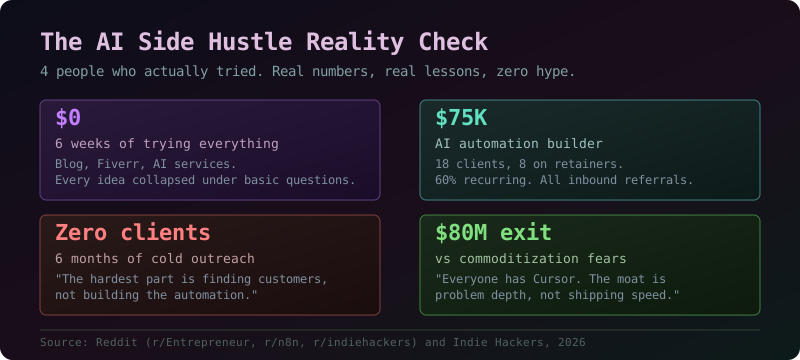
Key numbers: $50 (ChatGPT Plus) + $20 (Ghost blog) + 6 weeks of full-time effort. Return: $0.
What broke first: Every idea that sounded good collapsed when they asked basic questions — “Who is actually paying for this? Why would they pay me? What work already exists? What cost is being replaced?”
The real lesson: The user’s observation about who actually makes money with AI is the most honest breakdown I’ve seen. They identified four categories: people who already had an audience, people selling to people who want to make money with AI, people who would earn the money anyway and AI gets the credit, and people who are exaggerating or lying.
“AI is useful. I still use it. But as a way for an individual to create new income from scratch? I just don’t see it.”
Source: Reddit r/Entrepreneur — “I spent 6 weeks trying to make a very modest income with AI. Here’s what actually happened” (Jan 2026, 307 upvotes, 185 comments)
2. The $75K Automation Builder Who Learned the Hard Way
A very different story comes from u/Warm-Reaction-456 on r/AI_Agents, who accidentally built a $75K AI automation business over about a year. It started when a SaaS founder asked if they could “set up some AI thing” for lead follow-ups. They quoted $2,500, built it over a weekend with Zapier and GPT, and cut the client’s first-response time from 14 hours to under 3 minutes. That client told a friend. The friend called.
Their first five clients all came from referrals. No website, no portfolio, no pricing page. Just a WhatsApp message saying “the guy who fixed our lead flow.”
Key numbers: $75K total revenue. 18 clients. Average project: ~$4,200. 8 clients on monthly retainers ($500-$1,500/month). 60% of revenue is recurring. 3 retainer clients for 8+ months. $11K in referral revenue from just 2 clients.
What first broke: A $2,000 flat-fee project ate six weeks of work. “That client is the reason I now send a scope document before I touch anything.” Then a dentist’s office project started clean at $3,000 but ballooned into a mess that needed patching for two months because they kept saying yes to every request.
The fix: They switched from flat-fee pricing to build fee ($3,000-$7,000) plus monthly retainer ($500-$1,500). The retainer covers monitoring, tweaks, and the fact that “these systems break quietly. APIs update. Rate limits change. A form field gets renamed and suddenly nothing flows.”
Smartest move: Picking boring businesses. “My best clients aren’t tech companies. They’re dental offices, HVAC companies, real estate teams, insurance brokers. They don’t comparison shop. They don’t ask for a technical proposal with an architecture diagram. They just want the problem gone.”
The real lesson: “Don’t sell AI. Sell the outcome. Not once has a client asked me what model I’m using. They want to know how fast their leads get a reply.”
Source: Reddit r/AI_Agents — “I made $75K selling AI automations to clients. Here’s what I’d change if I started over” (Jun 2026, 391 upvotes, 187 comments)
3. The Client Acquisition Desert — Where Everyone Is Selling and Nobody Is Buying
On r/n8n, a solo founder posted a question that perfectly captures the state of the AI automation space in 2026: “Where do you actually find clients?”
They had been running an AI automation business for months. Niche: general. Outreach channels: cold email, Upwork, YouTube, X/Twitter, Reddit. Result: “I haven’t made any real money yet.” The problem isn’t building — it’s that “everyone is trying to sell to business owners at the same time, and now those business owners are just getting hit with spam from every direction.”
On r/automation, a similar thread with 142 upvotes and 311 comments asked the same question. A software developer with an existing CRM/ERP implementation business was skeptical about whether AI automation was as big as the hype suggested. “Most AI automation tools today seem to focus on small-scale tasks — lead generation, customer support chatbots, simple workflow automations. These solutions don’t seem to attract high-ticket clients.”
What worked for some: One commenter from Brazil shared a playbook that actually worked. They built a customer service agent specifically for clinics. With their first client, they offered a deal: implement the AI agent for free for 2 months. If it didn’t generate results, shut it down. If it worked, the client would pay a monthly fee and record a video testimonial. That social proof — a doctor recommending the agent to other doctors — made it easy to close five more clinics.
What didn’t work: Cold email, Upwork, generic YouTube content, generalist positioning.
The real lesson: “The most important question is not what to offer, but who to offer whatever you can offer to. You can rent boats all day long but if you do it in a desert you will not find many customers.”
Sources: Reddit r/n8n — “Where do you actually find clients in the AI automation space?” (Apr 2025, 68 upvotes, 96 comments); Reddit r/automation — “Anyone Having Success with an AI Automation Business?” (Feb 2025, 142 upvotes, 311 comments)
4. The Solo Founder Gold Rush — Golden Age or Bubble?
On r/indiehackers, a post in March 2026 captured the tension in the air. The wins are undeniable: Base44 got acquired by Wix for $80 million — built by one guy from his apartment, no investors, no employees, went from idea to exit in 6 months. Cameron Trew hit $2K MRR in 90 days building Kleo with Claude Code and Cursor. “The pattern is clear: AI coding tools are compressing what used to take teams months into something one person can ship in weeks.”
But the same post asks the question nobody wants to answer: “If everyone can build this fast, doesn’t competition get insane? The same tools that let you ship in 4 weeks let 50 other people ship the same thing.”
The key insight from the comments: “The moat isn’t the AI tool. Everyone has Cursor. Everyone has Claude. The moat is problem depth — how well you understand who you’re building for and why they’re frustrated. Speed to ship is table stakes now. Depth of insight is the new competitive advantage.”
The hidden cost: One commenter pointed out that Base44’s founder said publicly he felt completely isolated the whole time. “$80 million exit. Still lonely. The tools handle execution. They don’t handle the part where you need someone to push back on a bad assumption before you’ve built six months toward it.”
The real lesson: “The tools got better, not the founders. What used to take a team of 5 and six months, one person can ship in a weekend now. That compresses the timeline but doesn’t change the fundamentals. You still need distribution and you still need to solve a real problem. The ones winning fast are the ones who figured out those two things first, not the ones who vibe-coded the fastest MVP.”
Source: Reddit r/indiehackers — “solo founders are winning faster than ever right now — but is it sustainable or a bubble” (Mar 2026, 58 upvotes, 190 comments)
The Common Thread
1. Building is the easy part now.
The barrier to entry has collapsed. Anyone with a weekend and a Cursor subscription can build something functional. That’s not the bottleneck anymore.
2. Distribution is the new moat.
Every single story in this article confirms it. The $75K builder got all his clients from referrals. The $0 experiment tried Fiverr and got nothing. The Brazilian clinic automation worked because of a single video testimonial. You can build the best automation in the world, but if nobody knows you exist, you make zero dollars.
3. Domain expertise beats AI proficiency.
The people making money aren’t the ones who know the most about GPT model variants or prompt engineering. They’re the ones who understand a specific industry’s pain points so well they can solve them without the client needing to understand the tech.
4. The numbers are real, but they take work.
$75K over a year is real money. But after tool costs and taxes, it’s not “quit your job and buy a Lamborghini” money. The $0 experiment is also real. Six weeks of effort with nothing to show is the outcome that doesn’t make it into the YouTube thumbnails. Both are true at the same time.
5. Retainers turn a project into a business.
The single biggest structural difference between the $0 story and the $75K story is recurring revenue. One-time builds make you a freelancer. Retainers make you a partner. The difference is whether you’re selling a project or selling an outcome.
• Reddit r/Entrepreneur — “I spent 6 weeks trying to make a very modest income with AI. Here’s what actually happened” (Jan 2026)
• Reddit r/AI_Agents — “I made $75K selling AI automations to clients. Here’s what I’d change if I started over” (Jun 2026)
• Reddit r/n8n — “Where do you actually find clients in the AI automation space?” (Apr 2025)
• Reddit r/automation — “Anyone Having Success with an AI Automation Business?” (Feb 2025)
• Reddit r/indiehackers — “solo founders are winning faster than ever right now — but is it sustainable or a bubble” (Mar 2026)