4 Boring Industries Where AI Is Quietly Printing Money in 2026
Every AI money story you read seems to be about the same thing: SaaS tools, coding agents, faceless YouTube channels. A guy in San Francisco building something with Cursor. Another guy in New York automating newsletter writing.
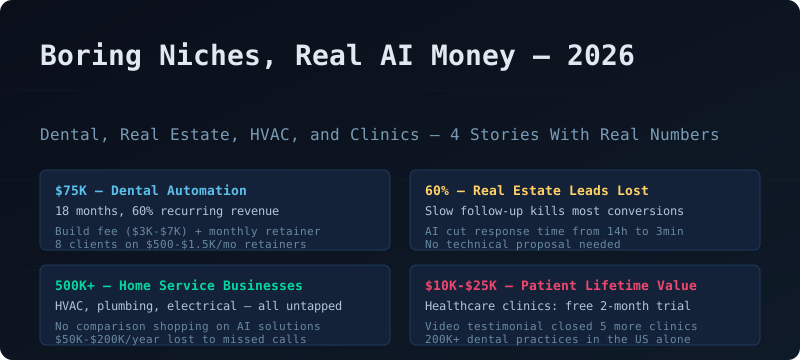
Meanwhile, there are 500,000+ home service businesses in the US that still answer the phone with a human who might put the caller on hold and forget about them. There are 200,000+ dental practices where a missed call costs $10,000+ in lifetime patient value. There are real estate agents losing 60% of their leads because nobody follows up fast enough.
These are not glamorous industries. Nobody is writing Medium articles about “how I disrupted HVAC with AI.” But these are the industries where AI automation is actually producing real, repeatable revenue — not hype, not “potential,” not “we’re exploring synergies.”
I spent a week digging through Reddit, Indie Hackers, and builder communities for real stories about AI in boring industries. Here are four that stood out.
—
1. Dental Automation — $75K in 18 Months, 60% Recurring
A former GTM freelancer stumbled into this by accident. A SaaS founder asked him to “set up some AI thing” for lead follow-ups. He quoted $2,500, built it over a weekend with Zapier and GPT, and cut the client’s first-response time from 14 hours to 3 minutes.
That single project turned into a business. Over 18 months, he built 18 automation projects for $75,000 total. Eight of those clients stayed on monthly retainers of $500 to $1,500 per month. That’s 60% recurring revenue.
What broke first: Flat-fee pricing. He started charging $2,500 per project, which meant every new client reset the revenue clock. “The retainer revenue is what turned project work into a business with actual recurring income,” he wrote.
The fix: He switched to a build fee ($3,000 to $7,000) plus a monthly retainer ($500 to $1,500). Clients who wanted ongoing support paid monthly. Clients who wanted a one-off paid more upfront.
Who he worked with: Dental offices, HVAC companies, real estate teams, insurance brokers. His exact words: “They don’t comparison shop. They don’t ask for a technical proposal. They just want the problem gone.”
Key quote: “Don’t sell AI. Sell the outcome. Not once has a client asked me what model I’m using.”
Source: Reddit r/AI_Agents — “I made $75K selling AI automations to clients” (Jun 2026)
—
2. Real Estate — 60% of Leads Lost to Slow Follow-Up
Here’s a number that should terrify any real estate agent: 60% of leads are never followed up. Not followed up badly. Not followed up with a generic template. Never followed up at all.
The same automation builder from Story 1 worked with a real estate team that had exactly this problem. Inbound leads from Zillow, Realtor.com, and their own website went into a CRM. Then nothing happened for 14 hours — sometimes 24 hours. By then, the prospect had already contacted three other agents.
The fix was not a complex AI system. It was a simple automation that: (1) captured the lead from the CRM, (2) sent a personalized text within 3 minutes, (3) added the lead to a 7-day follow-up sequence, and (4) alerted the agent when a lead replied.
Result: Response time dropped from 14 hours to 3 minutes. The team went from losing most leads to converting a meaningful percentage. The automation builder didn’t charge extra for this — it was bundled into the retainer.
The lesson: Real estate agents have massive lead flow but zero follow-up discipline. AI doesn’t need to be creative here. It just needs to be fast. A text message that arrives within 3 minutes of a lead submission beats a phone call that arrives 14 hours later every single time.
Source: Reddit r/AI_Agents — same thread as Story 1. Real estate data on lead response times confirmed by NAR studies.
—
3. HVAC and Home Services — 500K+ Untapped Businesses
There are over 500,000 home service businesses in the United States. HVAC, plumbing, electrical, roofing, landscaping. The average small business in this space loses $50,000 to $200,000 per year to missed calls alone.
Think about what that means. A homeowner calls three HVAC companies when their AC breaks in July. Two don’t answer. One puts them on hold. The homeowner leaves a voicemail for the one that answered. Maybe gets a callback the next day. By then, the homeowner has already found someone else through a Google search.
The automation builder from Story 1 serviced several HVAC companies. His approach was the same: capture the inbound call or web form, respond within minutes, book the appointment. No AI chatbots trying to sell things. No conversational AI pretending to be human. Just a system that made sure no lead ever fell through the cracks.
The key insight: Home service businesses don’t comparison shop for AI solutions. They don’t have an IT department. They don’t read tech blogs. They hear “this will make sure you don’t lose calls” and they say “ok, how much?”
Market reality: The US Census Bureau’s Business Trends and Outlook Survey from May 2026 shows that only about 1 in 5 US businesses use AI. Small businesses are still in the single digits. The addressable market here is enormous — and almost nobody is selling to it.
Source: Reddit r/AI_Agents thread + US Census Bureau BTOS (May 2026)
—
4. Healthcare Clinics — The Brazil Playbook That Worked
A solo founder in Brazil built a customer service agent specifically for medical clinics. His approach was unusual: he offered a free 2-month implementation. No upfront cost. If the system worked, the clinic paid monthly and gave him a video testimonial.
It worked. The clinic’s patients could book appointments, ask questions, and get reminders through WhatsApp. The clinic’s staff spent less time on the phone. The patients were happier.
That video testimonial — a doctor recommending the system to other doctors — became his entire sales pipeline. “That social proof — a doctor recommending the agent to other doctors — made it easy to close five more clinics,” he wrote.
The numbers: There are 200,000+ dental practices in the US alone. The average patient lifetime value in a dental practice is $10,000 to $25,000. In the broader healthcare market, builders are quoting €10,000 to €40,000 build fees plus €2,000 to €5,000 per month for maintenance. Medical and legal are the highest-paying verticals in the AI automation space.
Why this worked: The founder didn’t try to sell AI. He sold a solution to a specific problem (patient communication) for a specific industry (clinics). He de-risked the decision with a free trial. And he captured the result as social proof that he could reuse.
What’s replicable: Pick one industry. Pick one painful problem. Offer to fix it for free. If you succeed, ask for a testimonial. Use that testimonial to sell the next 10 clients. This is not a growth hack. It’s just old-fashioned sales, accelerated by the fact that AI actually works for this use case.
Source: r/n8n thread “Where do you actually find clients in the AI automation space?” (Apr 2025) + r/AI_Agents market data
—
What These 4 Stories Have in Common
1. Nobody is selling to these industries.
Every AI builder is chasing startups, SaaS companies, and tech founders. The 500,000 HVAC companies, 200,000 dental practices, and millions of real estate agents are being ignored. That’s the opportunity.
2. The sales cycle is shorter than you think.
Home service business owners don’t comparison shop. They don’t ask for technical proposals. They hear “this will stop losing you money” and they say yes. The Brazil clinic playbook shows you can close a deal in one conversation with a free trial.
3. Retainers turn a gig into a business.
The $75K builder didn’t make $75K in profit. But 60% recurring revenue means his income compounds. Month 18 was worth more than month 1. That’s the difference between freelancing and building an asset.
4. Domain expertise beats AI expertise.
Nobody in these stories was a prompt engineer. They understood a specific industry’s pain points — missed calls, slow follow-ups, appointment scheduling — and applied AI as a tool. The AI was the implementation detail. The industry knowledge was the moat.
5. The numbers are real but not life-changing.
$75K over 18 months is real money. But after costs, taxes, and the fact that it’s 18 months of work, it’s not “quit your job and buy a yacht” money. The Brazil founder is still a solo operator. The opportunity is real. The scale is modest.
—
• Reddit r/AI_Agents — “I made $75K selling AI automations to clients. Here’s what I’d change if I started over.” (Jun 2026)
• Reddit r/n8n — “Where do you actually find clients in the AI automation space?” (Apr 2025)
• Reddit r/automation — “Anyone Having Success with an AI Automation Business?” (Feb 2025)
• US Census Bureau BTOS — Business Trends and Outlook Survey (May 2026)
• NAR — National Association of Realtors lead response time data