AI Pricing Models in 2026: Why Per-Seat Is Dying and What Actually Works Now
I started looking into AI pricing after noticing a pattern in the indie hacker and SaaS communities: the founders who were making real money had stopped charging per seat, and the ones struggling were still using 2022 pricing logic. The data backs this up hard. I pulled pricing pages, founder interviews, and investor reports to map what is actually happening right now.
The short version: per-seat pricing is collapsing, hybrid models are taking over, and the gap between good pricing and bad pricing is now the difference between profitable and burning cash.
—
## 1. The per-seat collapse
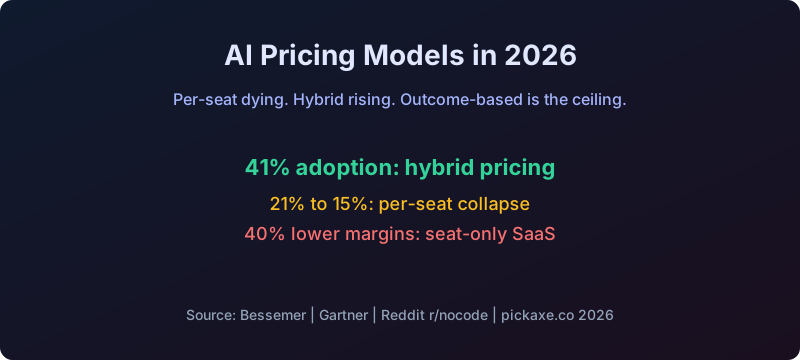
Bessemer Venture Partners tracked 200 plus AI vendors and found that pure per-seat pricing dropped from 21 percent to 15 percent of the market in twelve months. At the same time, hybrid pricing surged from 27 percent to 41 percent adoption.
The margin impact is not subtle. Companies still using traditional per-user pricing see 40 percent lower gross margins and 2.3 times higher churn than those using usage-based or outcome-based models. The reason is straightforward: AI tools are not like Slack seats. One user can burn ten times the compute of another, but both pay the same. The heavy users subsidize themselves at the expense of margins.
Replit is the cautionary tale. Their gross margins swung from 36 percent to negative 14 percent in months as their AI agent consumed more LLM resources than their pricing covered. Cursor burned through 500 requests from a single developer in one day after switching their pricing model. That is not a bug. That is the structural problem with treating AI like a SaaS subscription.
**What broke first:**
Treating AI output as if it had the same cost structure as hosted CRMs or project management tools. AI has variable compute costs that scale with usage, not just a fixed server bill.
**The fix:**
Shift to models that tie price to value delivered or actual consumption. Hybrid base plus usage, per-resolution, or outcome-based pricing all align the customer’\”s cost with the value they receive.
*Source: Bessemer Venture Partners 2026 AI Pricing Playbook; news.aakashg.com “How to Price AI Products”; Pilot.com “The New Economics of AI Pricing”*
—
## 2. The three models that are winning
After mapping the pricing pages of the top 50 AI startups by valuation, the landscape splits into six approaches, but three are winning in 2026.
**Per-seat:**
Still common for internal productivity tools where usage is uniform. Microsoft Copilot, Notion AI. Works when every user generates roughly the same workload. Breaks badly for customer-facing AI where one client can trigger 100 times more requests than another.
**Usage-based:**
Per token, per request, per resolution. Intercom charges $0.99 per AI resolution. A single company’\”s bill swings from $50 to $30,000 per month depending on how good the bot gets. This is honest pricing, but it creates billing anxiety for customers. Nobody likes an invoice that varies tenfold.
**Hybrid:**
Base fee plus usage overage. The base covers infrastructure and support. The overage captures heavy users without penalizing light users at full cost. This model rose from 27 percent to 41 percent adoption in twelve months because it balances predictability with scalability.
**Outcome-based:**
Charge for results, not usage. A lead-gen agent that books ten appointments costs more than one that books two. This is the most aligned model but requires clear success metrics and trust. It works best in vertical AI where the outcome is measurable: appointments booked, tickets resolved, documents reviewed.
**The hybrid subscription plus usage model is especially smart because it protects margins while scaling adoption.** That quote from a LinkedIn pricing thread captures exactly why this became the dominant pattern in 2026.
*Source: korixinc.com “AI Pricing Models 2026”; pickaxe.co “AI Agent Pricing Models Explained”*
—
## 3. What no-code AI builders are actually charging
The no-code AI space is where pricing gets weirdly honest. Reddit threads and indie hacker posts show actual revenue numbers from people building AI apps without code.
One builder posted making $2,000 to $3,000 USD so far from AI no-code apps, spending only $250 on subscriptions. The apps target existing frameworks like WordPress. Another commenter put it plainly: people making money are usually running micro-SaaS, internal tools, lead-gen automations, or niche vertical assistants. Revenue ranges from $500 to $5,000 per month once they find product-market fit.
**The real pattern:**
Not the app store lottery. Distribution-first plays with a specific audience. The no-code tools compress build time from four to six months down to two to four weeks, but they do not compress the distribution problem. Most of the real wins come from builders who already had an audience or a niche community.
NAR’\”s 2025 Technology Survey found that 68 percent of real estate agents now use AI tools, with 20 percent using them daily. The gap between agents using ChatGPT for listing descriptions and those using purpose-built AI for predictive leads and valuations is enormous and widening. That gap is where pricing power lives.
**What broke first:**
Pricing too low because the builder assumed no-code meant low-value. The apps that charge $500 to $5,000 per month are solving specific workflow problems for specific audiences, not generic “AI assistant” tools.
**The fix:**
Price by outcome and audience, not by feature count. A real estate lead-gen tool that books three appointments per week is worth more than a generic chatbot builder.
*Source: Reddit r/nocode — “Anyone actually making money with AI no-code apps? Real numbers?” — February 2026; NAR 2025 Technology Survey; TECHSY “AI for Real Estate 2026″*
—
## 4. The agent retainer pricing window
AI agent monetization has settled into a narrow range that surprises most newcomers: $300 to $1,500 per month per local business client. This comes from watching thousands of creators and small agencies on Pickaxe, where the platform tracks actual agent deployments.
The math is clean. A lead-generation agent for a restaurant or dental practice costs roughly $50 to $200 in API and hosting fees per month to run. The client pays $500 to $1,500. That is not software margin. That is consulting margin disguised as SaaS.
The catch is distribution. Most solo founders building AI agents fail not on the product but on the sales cycle. Local businesses do not buy software from Twitter threads. They buy from referrals, local meetups, and proof points in their own market. The founders making money are combining agent builds with existing relationships or local SEO presence.
One agency owner in Denver dropped two separate tools costing $350 per month for link research and replaced them with a $79 per month alternative. Her exact quote: “My margins are grateful.” That is the agent economy in microcosm: the money is in the workflow integration and the retainer, not the API markup.
**What broke first:**
Pricing agents like software products instead of service contracts. When the underlying model changes or the client’\”s needs shift, a seat-based model breaks. A retainer model adapts.
**The fix:**
Start at $500 to $1,000 per month with a one-month pilot. Price based on the labor cost you are replacing, not the API cost you are incurring. If your agent saves a business ten hours per week at $30 per hour, the value is $1,200 per month. Charge $600 and you look like a bargain.
*Source: pickaxe.co “How to Monetize AI Agents in 2026”; indie hacker and agency pricing threads*
—
## 5. The hidden cost nobody budgets for
Here is the detail that sinks most AI product launches: compute costs are variable and non-linear. A prompt that costs $0.01 today can cost $0.05 tomorrow if the model changes pricing or if usage spikes. The companies that win are the ones with FinOps-style cost governance built in from day one.
Gartner projects that by 2026, developers outside formal IT departments will account for at least 80 percent of the user base for low-code and no-code tools, up from 60 percent in 2021. The risk is not that citizen developers build bad apps. It is that they build apps without cost visibility. A marketing team can burn $5,000 in API costs in a week with an unmonitored AI workflow.
The tools that survive this phase will be the ones with transparent usage dashboards, hard caps, and anomaly alerts. The ones that hide their pricing behind “contact us” will lose to platforms that show per-request costs upfront.
**What broke first:**
Launching without a compute budget. The founders who hit $30,000 monthly bills from Intercom-style per-resolution pricing did not fail because the product was bad. They failed because the pricing model was exposed to usage spikes they did not anticipate.
**The fix:**
Add cost governance before you add features. Track API spend per customer, set soft limits, and build alerts for anomalies. This is boring infrastructure work. It is also what separates sustainable AI businesses from expensive experiments.
*Source: Gartner 2026 low-code projections; Mordor Intelligence No-Code AI Platform Market; Intercom AI resolution pricing*
—
## The pattern across all five stories
**1. Pricing must match cost structure.**
AI has variable compute costs. Per-seat pricing only works when usage is uniform. Everything else is a subsidy waiting to break.
**2. Hybrid is the safe middle ground.**
Base fee for predictability, usage component for scalability. This model won because it protects both sides: the seller’\”s margin and the buyer’\”s budget.
**3. Outcome-based pricing is the ceiling, not the floor.**
It works best in vertical AI where success is measurable. It fails in generic tools where “success” is subjective. Know which category you are in before you set your pricing page.
**4. No-code does not mean low-price.**
The $500 to $5,000 per month no-code wins are solving specific problems for specific audiences. The builders treating no-code as a race to the bottom are the ones posting about app store failure.
**5. Compute cost governance is table stakes.**
Launch without usage visibility and you are one viral thread away from a $30,000 bill. Build cost tracking into the product, not as an afterthought.
—
• Bessemer Venture Partners — “2026 AI Pricing Playbook” — https://www.pilot.com/blog/ai-pricing-economics-2026
• news.aakashg.com — “How to Price AI Products: The Complete Guide for PMs (2026)” — https://www.news.aakashg.com/p/how-to-price-ai-products
• korixinc — “AI Pricing Models 2026: Per-Seat, Per-Use and Outcome Compared” — https://korixinc.com/learning-center/ai-pricing-models-2026
• Reddit r/nocode — “Anyone actually making money with AI no-code apps? Real numbers?” — https://www.reddit.com/r/nocode/comments/1r7yy73/
• pickaxe.co — “How to Monetize AI Agents in 2026” — https://pickaxe.co/post/monetize-ai-agents-2026
• Gartner — “No-Code AI Platform Market Size, Growth, Share and Trends Report 2031” — https://www.mordorintelligence.com/industry-reports/no-code-ai-platform-market
• TECHSY — “AI for Real Estate 2026: 10 Tools That Close Deals” — https://techsy.io/en/blog/ai-tools-for-real-estate