How to Find Micro SaaS Ideas That Actually Sell in 2026 — 4 Builders Who Cracked the Code
There’s a weird thing happening in the indie SaaS world right now. Building has never been cheaper. A solo founder can ship an MVP in a weekend with Cursor, Supabase, and Vercel. The hosting is free. The AI tools are $20/month. The technical barriers that used to stop people from starting just don’t exist anymore.
But the success rate hasn’t gone up. If anything, it’s gone down. Because the hard part was never building. It was always finding something people would actually pay for, and then getting them to see it.
I looked at four builders who cracked this problem. Their stories are different, but the patterns are the same. Here’s what they actually did.
1. The $9K/Month Founder Who Stopped Guessing
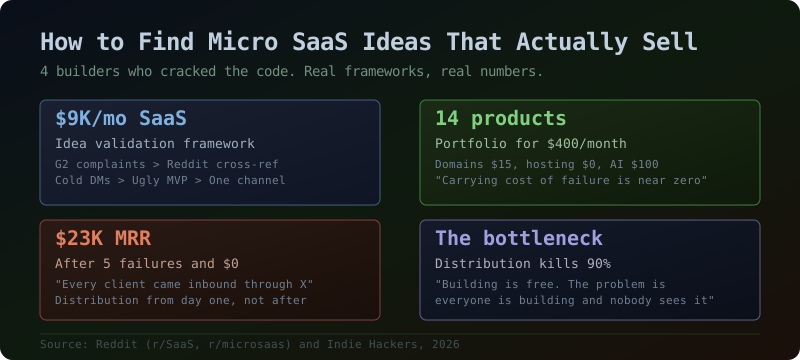
In April 2026, a Reddit user on r/SaaS shared something rare: a detailed, step-by-step breakdown of how they’d find a SaaS idea if they had to start over. They had just crossed $9K in monthly revenue with 700 paying users, after 12 months of grinding. But the first 6 months were a disaster — two products built from “shower thoughts,” zero revenue from both.
Here’s the exact framework they’d use next time:
Day 1-3: Stop brainstorming. Go straight to G2 and Capterra. Filter by 1-2 star reviews in boring B2B categories — invoicing, scheduling, inventory, CRM. Ctrl+F for “doesn’t have,” “wish it could,” “missing feature.” Read 200 reviews minimum. “Frustrated paying customers = validated demand. That’s the only formula that matters.”
Day 4-7: Cross-reference on Reddit. Take the top 3 complaints and search Reddit for the same frustrations. Look for threads with 20+ comments where people are agreeing. “When the same complaint shows up on G2 AND Reddit AND app store reviews, you’ve found something real.” Also check Upwork — “repetitive tasks being outsourced = best SaaS ideas because someone is literally paying humans to do something software could handle.”
Day 8-10: Validate with 10 cold DMs. Find people who left those negative reviews. Message them directly: “Hey, I saw you mentioned X problem. I’m thinking about building something that fixes this. Would you pay $30-50/month?” Three out of ten saying yes is enough. “I skipped this step on my first 2 products. Cost me about 4 months of wasted building.”
Day 11-25: Build the ugliest MVP possible. Scope it to one feature. The single biggest complaint. No dashboard, no onboarding flow, no admin panel. “My first successful MVP looked terrible. Basic UI, barely functional. 14 people signed up in the first week and 9 converted to paid. Ugly product, real problem = revenue.”
Day 26-30: One channel. Pick Reddit and nothing else. Find subreddits where your target users hang out. Share what you learned during research. When someone posts about the exact problem you solve, reply with your experience.
What didn’t work: Building for developers (“they expect everything to be free”) and consumer apps (“consumers churn in weeks. B2B users with existing budgets stick around for years”).
The real lesson: “Stop guessing what people want. Let angry paying customers tell you. The best SaaS ideas in 2026 are complaints that keep repeating across multiple platforms from people already spending money on bad solutions.”
Source: Reddit r/SaaS — “My SaaS hit $9K/month. If I had to start over, here’s how I’d find the best SaaS ideas in 2026” (Apr 2026, 288 upvotes, 238 comments)
2. The 14-Product Portfolio — Experimenting for $400/Month
Jakub runs Inithouse, a portfolio of 14 micro-SaaS products. He published a full breakdown of what it costs to run them all, and the number is shocking: under $500/month.
Key numbers: 14 products. Domains: ~$15/month (Cloudflare at cost). Hosting: $0 (all built with Lovable, deployed on free tiers, Supabase free tier for auth and databases). AI API credits: $80-120/month (OpenAI and Anthropic). Dev tools: $30-50/month (one Lovable subscription covers all 14). Google Ads for validation: $100-200/month (optional, $5-15/day per campaign). Misc: $10-20/month. Total: $235-405/month.
The math: “If each product cost $500/month to run, 14 of them would be $7,000/month — and I’d need revenue fast just to survive. At $25-30/month per product, I can run experiments for months, watch the data, and double down on winners without financial pressure.”
What this means: The portfolio strategy that VCs use — spreading bets across many shots on goal — is now accessible to solo founders. Most products won’t work. But the downside (carrying cost of a failed experiment) is nearly zero, while the upside (finding PMF in one of 14 niches) is uncapped.
The real lesson: “Three years ago, this would have required a team of developers, DevOps, designers — easily $15-20K/month minimum. The AI-native stack has reduced the cost of experimentation by at least an order of magnitude. The unlock is not just building faster, but maintaining cheaper.”
Source: Indie Hackers — “The Real Monthly Cost of Running 14 SaaS Products Solo” by Jakub (May 2026)
3. Five Failures, Then $23K MRR in Six Months
Rob Hallam spent two and a half years failing to grow five products. Total revenue: $0. He was getting seriously anxious about money. “Living in financial scarcity messes with your head in ways that are hard to explain until you’ve been there.”
Desperate, he started a dev agency to keep the lights on. Then he noticed something: every single client was coming inbound through X (formerly Twitter). Every time a post did well, his DMs filled up. The problem was he couldn’t make it happen on demand. Some posts blew up, others flopped, and he had no idea why.
So he started building tools to reverse-engineer what was working. That became SuperX, a platform that helps people grow on X. He partnered with a co-founder, rebuilt everything from scratch, and six months after launch, it hit $23K MRR with 650 paying customers at $39/month.
Key numbers: $23K MRR. 650 paying customers. Growing 20-25% month over month. 95% of users from organic content. $5K total spent on ads. 30% free trial to paid conversion. 900 followers to 40K by posting daily.
What broke first: X kept changing their API. “I’d wake up to dozens of messages saying SuperX was down.” He got hospitalized twice while traveling — food poisoning in Guatemala, stress-induced neck spasms in Colombia.
The distribution strategy: “I set myself a goal: post a video every day until I hit $10K MRR. It sounds simple, but most people don’t do it. They post when they feel like it, get discouraged when something flops, and disappear for a week. The algorithm forgets you fast.” He followed a loop: start with something entertaining or vulnerable to get attention, follow up with educational or a product demo, then post the results (signups, revenue) to make it inspirational.
The real lesson: “If I had to start over, I’d focus on distribution from day one. My first five products failed because nobody knew they existed. With SuperX, I built the audience and the product at the same time. Consistency compounds. You only get the big ones if you keep showing up.”
Source: Indie Hackers — “Hitting $23K MRR in Six Months After Five Failures” by Rob Hallam (Feb 2026)
4. The Distribution Problem — Why 90% of New Micro SaaS Will Die
This is the thread that ties everything together. On r/microsaas, the consensus is stark: the distribution problem is going to kill 90% of new micro SaaS products in the next year. Building is free. The problem is everyone is building, and nobody sees anything.
One commenter put it bluntly: “I studied 47 SaaS products that went from $0 to $10K MRR last year. None of them found their idea by brainstorming. They found it because they were already embedded in a community where the problem was obvious.”
Another added the key filter: “Not every repeated complaint is a business opportunity. Some are just annoying. The better signal is when the complaint already has a workaround people are paying for — a freelancer, an expensive tool, a manual process that takes hours. If they can describe the current workaround, what it costs, and what breaks when it fails, it’s worth digging into. If not, it’s probably just a loud annoyance.”
The real lesson: “The moat isn’t the AI tool. Everyone has Cursor. Everyone has Claude. The moat is problem depth — how well you understand who you’re building for and why they’re frustrated. Speed to ship is table stakes now. Depth of insight is the new competitive advantage.”
Source: Reddit r/microsaas — “The distribution problem is going to kill 90% of new micro SaaS” (2026); r/SaaS comments
What These 4 Stories Tell Us
1. Don’t guess. Go where there’s already money.
The $9K/month founder doesn’t brainstorm ideas. He reads complaints from people already paying for software. Jakub doesn’t pick niches. He builds quickly and lets the market tell him. The thread is the same: validated demand from people with budgets beats anything you can think up in a shower.
2. The portfolio model is the new default.
When it costs $400/month to run 14 experiments, putting all your eggs in one basket is irrational. The cost of trying something new is so low that the only mistake is not trying enough things.
3. Distribution is the product.
Rob’s five products failed because nobody knew they existed. His sixth succeeded because he built the audience and the product simultaneously. The $9K founder’s last step is “pick one channel.” Building without distribution is like opening a restaurant in a desert.
4. Complaint density is the new market research.
G2 reviews + Reddit threads + Upwork job posts = the modern focus group. If the same complaint shows up in all three places, you’re not guessing anymore. You’re responding to a signal.
5. Small bets, compound returns.
Every successful builder here started small. Not “small thinking” — small execution. One feature. One channel. One ugly MVP. The people who win aren’t the ones with the best ideas. They’re the ones who figured out how to test ideas cheaply and keep the ones that work.
• Reddit r/SaaS — “My SaaS hit $9K/month. If I had to start over, here’s how I’d find the best SaaS ideas in 2026” (Apr 2026)
• Indie Hackers — “The Real Monthly Cost of Running 14 SaaS Products Solo” by Jakub (May 2026)
• Indie Hackers — “Hitting $23K MRR in Six Months After Five Failures” by Rob Hallam (Feb 2026)
• Reddit r/microsaas — “The distribution problem is going to kill 90% of new micro SaaS” (2026)