The Uncomfortable Truth About AI Tool Pricing in 2026 — Dollar20/Month Traps, Fake Free Tiers, and the API Math Nobody Does
I spent the last month reading pricing pages. Not for fun — I was trying to figure out which AI tools are actually worth paying for in 2026. After digging through 40+ tools and reading an Indie Hackers thread that went viral for a reason, some patterns emerged that nobody seems to talk about openly.
Here’s the math, the traps, and what actually matters when you’re deciding where your money goes.
#1 — The “Free Tier” That’s Not Free
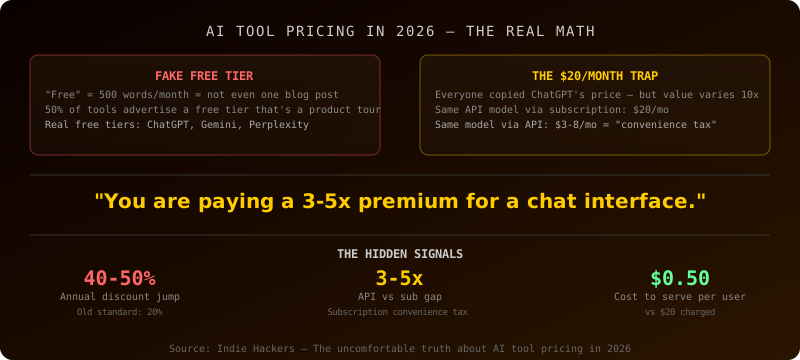
This is the most abused term in SaaS right now. At least half the AI tools I looked at advertise a “free tier” that’s basically a demo with a login screen. You can sign up, see the dashboard, run 2-3 prompts, and then hit a wall.
The worst offenders are AI writing tools. Almost every one I tested advertises “free” and then limits you to 500 words per month. That’s not enough to write a single blog post. It’s a free trial that never expires but also never becomes useful.
The tools that actually have usable free tiers — where you can do real work without paying — are surprisingly rare:
- ChatGPT — Legit free tier. You can actually use it.
- Gemini — Google gives you a shocking amount for free.
- Perplexity — Free tier is honestly good enough that you question why the paid plan exists.
Everything else? Read the fine print. If you see “free” and the word “credits” or “quota” in the same sentence, assume it’s a demo.
#2 — The $20/Month Trap
There’s a weird clustering around $20/month. ChatGPT Plus, Cursor Pro, Claude Pro, Midjourney — all roughly $20. It feels like every tool just looked at what OpenAI was charging and matched it without thinking.
The problem: $20/month tools vary by 10x in actual value. Some give you genuinely unlimited usage. Others give you a quota that runs out mid-month if you’re a heavy user. And a few charge $20 for what is essentially the same model you can access through the API for $3-5 in actual usage.
I started tracking cost-per-actual-use and the differences are absurd. Two tools charging the same monthly fee can differ by 10x in how much you can actually do before hitting limits.
The honest truth: you’re paying a 3-5x premium for a nice chat interface. If you’re technical and can set up a simple API wrapper in an afternoon, the subscription model is overpriced by design.
#3 — The API vs Subscription Gap Nobody Talks About
This is probably the most useful finding. For a lot of tools, the API pricing is dramatically cheaper than the subscription if you know how to use it.
- Claude or GPT-4 through the API for a normal user: $3-8/month
- Same model through subscription: $20/month
That’s a 3-5x premium for a chat UI. Obviously the subscription is worth it if you’re non-technical or use it all day. But for developers and builders, the chat interface is a convenience tax.
The tools that survive this era will be the ones where the pricing honestly reflects usage. The ones that die will be the ones still charging $20/month for something that costs them $0.50 to serve, hoping nobody does the math.
#4 — The Annual Discount Signal
20% off for annual billing used to be standard. Now I’m seeing 40-50% discounts for annual commitments on some AI tools. That’s not a pricing strategy — it’s an admission that monthly retention is broken.
My read on this: most people sign up for an AI tool, use it heavily for 2-3 months, then either find a free alternative or realize they don’t need it as much as they thought. The annual discount is the tool’s way of capturing revenue before that realization hits.
If you see a 40%+ annual discount on a new AI tool, ask yourself: why are they this desperate to lock people in?
The Patterns That Matter
- Free tier = demo unless proven otherwise. The exceptions are ChatGPT, Gemini, and Perplexity.
- $20/month is a cluster, not a value signal. Compare actual usage limits, not the price tag.
- API pricing is 3-5x cheaper than subscription for the same model. The chat UI is a convenience tax.
- Annual discounts above 30% signal broken monthly retention, not a good deal.
- Pricing is about trust, not cost. The products that win will be easier to understand under scrutiny — not just cheaper.
The AI tool pricing game in 2026 is designed to extract maximum value from buyer uncertainty. The fix is simple: do the math. Track your actual usage. Compare API vs subscription cost. And if a tool won’t show you its enterprise pricing, assume it’s because the number would make you walk.