AI Runs 70% of My Distribution — One Founders Dollar400 to Dollar19/Month Pivot and the 12 Things He Refuses to Automate
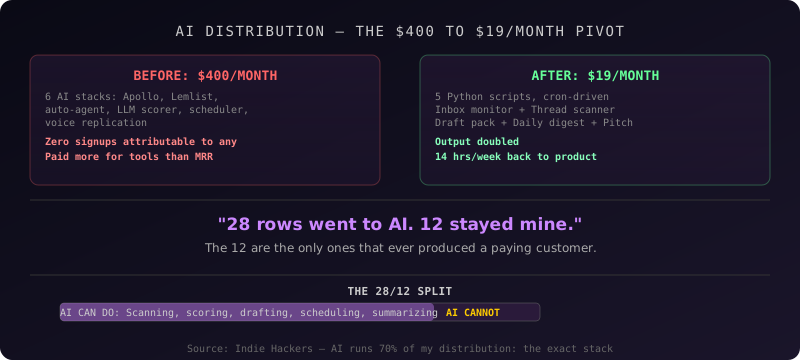
I found a post on Indie Hackers that changed how I think about AI and distribution. A solo founder named Max was running a productivity tool called Flowly. He spent four months buying every AI distribution promise on the timeline. Six stacks. $400/month at peak. Paid more for AI growth tools than he had collected in MRR that month.
Zero signups attributable to any of them.
Then he did something simple that most founders never do. He opened a spreadsheet, listed every distribution action he took in a week (40 rows), and labeled each one: “AI can do this” or “AI cannot do this without killing the channel.”
The 28/12 Split
28 rows went to AI. 12 stayed his. And the 12 he kept were the only rows that had ever produced a paying customer.
Here are the 12 that cannot be delegated:
- The final 30% edit of every shipped reply
- Picking which 1 or 2 daily AI-generated drafts are actually worth shipping
- Founder positioning calls — what stance to take this month
- Replying to any customer DM or email. Every one. Always.
- The hand-edit of the opener and closer of any long-form post
- Cold outreach to specific named humans (creators, journalists, podcasters)
- Any reply that names another person by handle
- Comments under his own posts
- Any time positioning against a named competitor
- Any pitch that requires reading 3+ pieces of the recipient’s prior work
- The choice of which channel to retire when a metric drops
- The closing line of every reply — AI cannot land a closer
Each of these failed when he delegated it. Three of them cost him actual customers.
The Never-Write List
The single most valuable artifact in his entire distribution setup is not a prompt or a tool. It’s a one-page “never-write” list. New rules show up every week, each one from reading a bad AI draft and tagging the exact line where his voice broke.
Sample rules:
- Never start a reply with “Great question.”
- Never use “leverage,” “unlock,” “synergy,” “in the trenches.”
- Never end a comment with a question if the post is over 60 words.
- Never name the product in the first 80% of any reply.
- Never quote a statistic without naming the source.
- Never use an emoji unless quoting someone else.
- Never write a sentence over 25 words in a draft for X or HN.
- Never close with “Hope this helps.”
Drafts produced with this list need a 30% edit. Drafts produced without it need a 70% edit — at which point you’re writing from scratch. The never-write list is the entire economic difference between “AI saves me time” and “AI costs me time.”
The $19 Stack
After the rebuild, his distribution setup runs on five scripts — about 200 lines of Python total — driven by cron, with Slack and email for human approvals:
- Inbox monitor: Polls Gmail every 2 hours for journalist queries, scores each against his 7 stances, lands a ranked list in Slack. Takes 90 seconds to review.
- Thread scanner: Pulls HN frontpage, X home, Bluesky timeline 3x daily. Returns top 5 candidates with a one-line “why this thread.”
- Draft pack generator: End-of-day script produces 5 ready-to-edit drafts across 5 channels. He edits roughly 30% before shipping.
- Daily digest: Analytics summary emailed at 9pm. 2 minutes to read.
- Pitch responder: Drafts journalist replies, 60-word constraint, founder voice. Always blocks on one-click approval. Always.
Total cost: $19/month. Drifts to $24 in heavy weeks. Founder hours pulled back into product work: about 14 per week.
He also had a costly lesson — one 8-day period where the pitch responder ran on auto-send with a low-confidence threshold. A journalist’s follow-ups went unanswered for 5 days while the script regenerated polite boilerplate. The story that eventually ran skipped his product. The fix: every outbound message now blocks on human approval. No exceptions.
What This Means for You
The core insight applies to anyone trying to grow something with AI in 2026:
- Do the 40-action sort before you buy another AI tool. List every distribution action you take in a week. Label each one. The second column — “AI cannot do this” — is the only thing you should spend founder hours on.
- Most people buying $400 AI growth stacks are paying to automate the 30% that converts and ignoring the 70% that bores them. They have it exactly backwards.
- The constraint lives upstream of the model, not inside it. A never-write list, a voice doc, a set of stance rules — these matter more than any prompt.
- If you cannot see the line between what AI did and what you did, you cannot price either one honestly.
The difference between $400/month and $19/month isn’t better tools. It’s knowing which work only you can do.