From Optician to 28K/Month: How Samuel Rondot Learned to Code and Built a Portfolio of SaaS Products
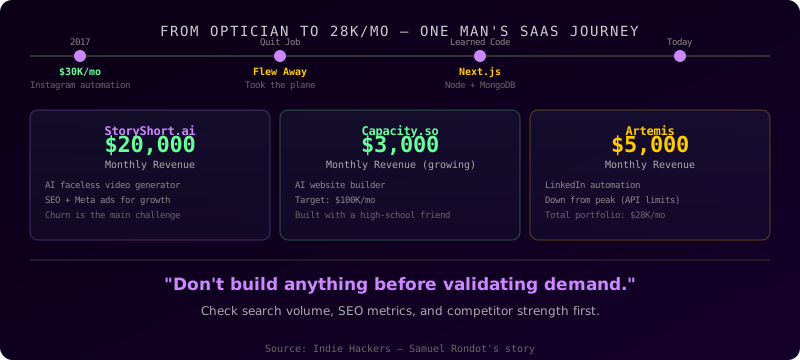
I found a story on Indie Hackers that reads like a movie script. A French optician stared at an airport from his apartment every day, watching planes take off while he was stuck in a shop. Eventually he built side projects, quit his job, learned to code, and now runs a portfolio of SaaS products doing $28,000/month.
His name is Samuel Rondot. Here’s exactly how he did it.
From Optician to $30K/Month Instagram Automation
Samuel worked as an optician for three years. He loved the job but hated being physically stuck in one place. He lived in France near the Swiss border, and from his apartment he could see the airport. Nothing physically prevented him from taking the next plane — except his job.
So he started building side projects before and after work. In 2017, he launched his first “business” — an Instagram automation service. It wasn’t even real code. Actual humans in India and Bangladesh performed the automation tasks behind a WordPress landing page.
It grew to $30,000/month.
He quit his job and finally took that plane.
The Portfolio: Three Products, $28K/Month
Samuel’s current portfolio consists of three products, each at different stages:
StoryShort.ai — $20,000/month
An AI tool that automatically generates short faceless videos. Started when he discovered a tool that could turn text into video. Growth comes from SEO and Meta ads. The challenge is naturally low lifetime value — churn is always a battle in this niche.
Artemis (useartemis.co) — $5,000/month
A LinkedIn automation tool. Revenue is down from its peak because LinkedIn tightened its API limits. This is a common pattern in the automation space — platform risk is real.
Capacity.so — $3,000/month and growing
An AI website builder. This is Samuel’s most ambitious project, built with a high-school friend. Before he learned to code, he was exactly the target user — someone who wanted to build custom software without hiring developers. Capacity is aiming for $100,000/month.
The Tech Stack That Got Him There
His stack is refreshingly simple and consistent across all products:
- Next.js for the frontend
- Node.js for the backend
- MongoDB for the database
- Vercel for frontend hosting
- AWS for backend hosting
Nothing exotic. No microservices. No Kubernetes. Just battle-tested tools that let him ship fast.
The Growth Strategy
Samuel uses a two-pronged approach that works for every product:
- SEO — The best long-term driver. It takes time but compounds. Six months later, you’re always glad you invested in it.
- Paid ads — Mostly Meta and Google. Predictable, scalable traffic for SaaS.
He also makes YouTube videos and optimizes for AI engines (GEO), getting about 400 clicks per day from those channels.
One key insight: he competes differently because most of his competitors have raised funding. They can afford to spend $200 to get a $30 sale. He can’t. So he focuses on channels where creativity beats budget.
The Advice That Actually Matters
Samuel’s two pieces of advice cut through the noise:
1. Use AI coding tools to build your MVP fast.
Even if you plan to code everything yourself later, tools like Cursor or Copilot help you get the first version out much quicker. Speed matters.
2. Don’t build anything before validating demand.
He’s surprised at how many smart indie hackers don’t know how to validate if an idea can make money. They just build random tools, then quit because they spent weeks building something that never earned a dollar.
Before starting a project, check:
- Search volume
- SEO metrics
- Competitor strength
- How competitors get customers
- Whether there is actual demand
Then prove that people will pay. If you can’t clearly see the path to money, don’t build it.
What This Means for You
Samuel’s story is not about luck. It’s a repeatable pattern:
- Start while employed. He built side projects for years before quitting.
- Validate before building. His first product had no code — just humans behind a landing page. It proved demand before he invested in tech.
- Keep the stack simple. Next.js, Node, MongoDB. Nothing fancy.
- Diversify your revenue. Three products, each at different stages, totaling $28K/month.
- Compete on creativity, not budget. SEO, content, and community beat VC-funded ad spend.
The path from “I can see the airport from my apartment” to “I run a $28K/month SaaS portfolio” is not a straight line. But it’s a path that’s been walked — and documented.