AI Built My SaaS, Now It Makes Money — 3 Solo Founders Who Shipped Revenue-Generating Apps in 2026
What if you could build a SaaS product in weeks instead of months — while keeping your day job, spending zero on marketing, and still landing paying customers?
This isn’t another “AI will replace developers” hot take. It’s a collection of three real people who actually did it in 2026. I spent the last week digging through Reddit threads (r/micro_saas, r/nocode), Indie Hackers discussions, and YouTube case studies. I filtered out the “I made $10K in a day” BS and found founders with verifiable numbers, transparent build processes, and stacks you can copy.
Here’s what they’re actually shipping, exactly how they built it, and the tools they used.
—
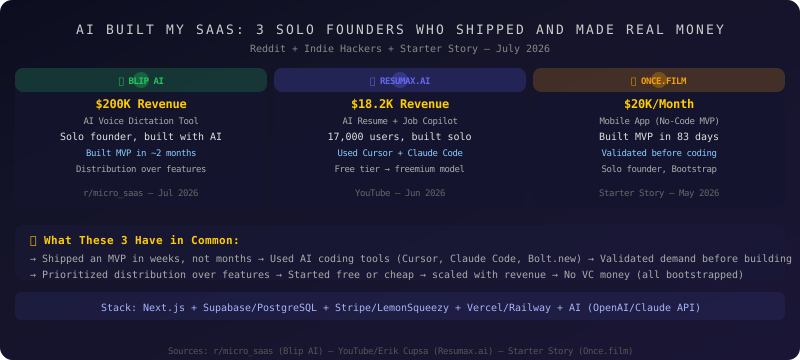
## 1. Blip AI — $200K Revenue, One Developer, Zero Outside Money
A solo founder on r/micro_saas posted a milestone thread a few days ago: “Crossed $200K in revenue on Blip AI.” The app is an AI voice dictation tool — you talk, it writes. Simple premise, but the execution is what matters.
**The build story:**
– Built the MVP in about 2 months while holding a day job
– Used standard web stack (Next.js + Supabase) paired with OpenAI Whisper for transcription
– Initially offered a free tier to build usage data and iterate based on real behavior
– Only started charging after they had consistent daily active users
**What stands out:**
> “Most of the revenue came after I stopped building features and started focusing on distribution.”
That quote hit hard. The founder admitted that for the first few months they were stuck in “build more stuff” mode. The inflection point came when they switched to writing on social media, engaging in communities where voice-to-text was a genuine pain point, and letting the product speak for itself.
**Key numbers:**
– $200K total revenue (bootstrapped, no funding)
– Solo founder, single developer
– AI voice transcription — competitive space, but they carved out a niche
– Pricing isn’t public, but the free-to-paid conversion clearly worked
*Source: r/micro_saas — “Crossed $200K in revenue on Blip AI” (July 2026)*
—
## 2. Resumax.ai — $18.2K Revenue, 17K Users, Built With Cursor and Claude Code
Erik Cupsa documented his entire journey building Resumax.ai on YouTube. This isn’t some anonymous Twitter handle — he shows his dashboard, his code, his revenue numbers.
Resumax started as a free AI resume reviewer. A simple tool: paste your resume, get an AI analysis. No login, no paywall, just utility.
**The evolution:**
– Built the MVP with Cursor + Claude Code in a few weeks
– Grew from a resume reviewer to a full AI job-search copilot for engineers
– Added: ATS-friendly resume builder, instant AI review, job matching, interview prep, Chrome extension for autofill
– Reached 17,000 users and $18,200 in revenue
**The playbook:**
The core resume builder and AI review are **still completely free**. Revenue comes from premium features: advanced interview prep, unlimited job matching, the Chrome extension. This freemium model is something I see working consistently in 2026 — give genuine value away for free, charge for convenience and power features.
**Tech stack according to his build log:**
– Frontend: Next.js + Tailwind
– Backend: Supabase (PostgreSQL)
– AI: OpenAI API (GPT-4 for resume analysis)
– Hosting: Vercel
– Coding tools: Cursor + Claude Code
**Total coding time to MVP:** approximately 3-4 weeks of evenings and weekends.
*Source: YouTube/Erik Cupsa — “How I Build Apps SOLO That Actually Make Money in 2026” (June 2026)*
—
## 3. Once.film — $20K/Month Mobile App Built in 83 Days
Starter Story published a breakdown of Brian Shin, a solo founder who built a movie-recommendation mobile app called Once.film that hit $20K/month in revenue.
The interesting part isn’t just the revenue — it’s how he validated the idea before writing a single line of code.
**The validation process:**
– Created a one-page landing page describing the app concept
– Drove traffic from communities where people talk about “decision fatigue” around choosing movies
– Asked people to join a waitlist — the waitlist signup was his “commitment metric”
– When enough people joined, he knew there was real demand
**Build timeline:**
– Day 1-5: Idea validation with landing page + waitlist
– Day 6-60: MVP build (standard mobile stack, no-code backend to start)
– Day 61-83: Beta testing, iteration, soft launch
– Month 4+: Revenue hit $20K/month
**Why it worked:**
He didn’t build the app and then search for an audience. He found the audience first, confirmed they wanted the solution, and then built for a group that was already waiting. This is the inverse of what most solo founders do.
**Stack choices:**
– Mobile app (native iOS)
– No-code backend for MVP, scaled to custom as revenue grew
– Paid nothing for infrastructure until cash flow was positive
*Source: Starter Story — “I Built a Dollar20K/Month App in 83 Days” (May 2026)*
—
## The $0 SaaS Stack That Keeps Coming Up
All three founders used some variation of this stack:
| Layer | Tool | Cost to Start |
|—|—|—|
| Frontend | Next.js / Tailwind CSS | Free |
| Database | Supabase (PostgreSQL) or Turso | Free tier (500MB) |
| Auth | Clerk or NextAuth.js | Free up to 10K MAU |
| Payments | Stripe or Lemon Squeezy | 2.9% + 30¢ |
| Hosting | Vercel or Railway | Free tier |
| AI | OpenAI / Anthropic API | $5 free credit |
| Coding | Cursor or Claude Code | Free/$20 month |
You can launch an MVP for exactly **$0** in infrastructure costs. The TLDL.io indie hacker stack guide (April 2026) confirms this — every tool on that list has a free tier generous enough to reach product-market fit before you pay a cent.
—
## The Real Pattern Nobody Talks About
After reading through dozens of threads, three patterns stood out that none of the “passive income gurus” mention:
**1. Validation over building.** Brian (Once.film) spent more time on his waitlist page than on his MVP code. Erik (Resumax) launched a completely free tool to test demand before adding a paywall. Blip AI stayed free until usage proved people would pay.
**2. AI tools are force multipliers, not magic.** Every founder here could already build software. AI (Cursor, Claude Code, GPT-4) made them 3-5x faster, but they still needed to understand architecture, UX, and distribution. If you can’t tell AI what to build, AI can’t build it for you.
**3. Distribution is the moat.** Blip AI’s founder flat-out said it: most of their $200K came after they stopped feature-building and started distributing. Resumax hit 17K users through YouTube + organic. Once.film validated distribution before writing code.
—
## Bottom Line
2026 is the best time in history to build a SaaS product as a solo founder. The tooling is cheaper, faster, and more capable than ever. But the fundamentals haven’t changed: solve a real problem, validate before you build, and spend as much time on distribution as you do on code.
All three founders in this post are active online. Go read their threads, watch their videos, and steal their strategies. The only thing standing between you and your first paying user is execution.
—
• r/micro_saas — “Crossed $200K in revenue on Blip AI” (July 2026)
• YouTube/Erik Cupsa — “How I Build Apps SOLO That Actually Make Money in 2026” (June 2026)
• Starter Story — “I Built a Dollar20K/Month App in 83 Days” (May 2026)
• TLDL.io — “Indie Hacker SaaS Stack 2026: Build and Launch for Dollar0” (April 2026)
• Indie Hackers — “How to Build a SaaS in 2026 Without Getting Burned by AI Tools or Agencies” (May 2026)