How This Solo Founder Hit Dollar125K MRR With a Survey Tool and Zero Funding
Most solo founder stories follow a familiar arc: build an MVP, launch on Product Hunt, struggle for users, maybe hit $5K MRR after a year.
Jason Zigelbaum’s story is not that.
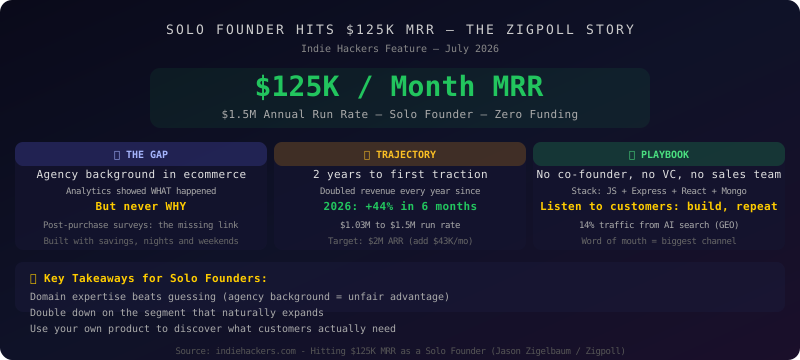
His survey tool Zigpoll hit **$125K MRR** in June 2026 — a $1.5M annual run rate — and he did it alone. No co-founder. No VC funding. No sales team. He started 2026 at $1.03M ARR and grew 44% in six months, adding nearly half a million in new annual revenue.
I read his full interview on Indie Hackers (published July 2, 2026) and here’s what actually mattered — the parts that don’t make it into Twitter threads.
—
## The Gap He Saw That Nobody Else Solved
Jason grew up in e-commerce, mostly on the agency side. He watched brands pour money into ads and analytics tools that told them *what* happened on their stores — carts abandoned, pages bounced, funnels dropped — but never *why*.
> “Analytics could tell them a cart was abandoned, but never why.”
That gap is what Zigpoll fills. It’s a survey and feedback platform that captures customers at the exact moment they’ll answer honestly: post-purchase, on exit intent, or after a support interaction. One question on a thank-you page (“What almost stopped you from buying?”) taught more than a $15K CRO audit.
**Key insight:** His agency background gave him a direct view of the problem. He wasn’t guessing — he’d watched dozens of e-commerce brands hit the same wall. That domain expertise is his unfair advantage.
—
## The Build: Funded by Savings and Late Nights
Building Zigpoll cost far more time than money. Jason is technical, so the first version was built with a code editor and nights/weekends. He never took outside money — no VC, no angel, no co-founder to split equity with.
> “I wanted one that was fully mine, one I could change on a Tuesday afternoon without asking permission.”
He funded the gap with revenue from another app (which required only a couple of hours per week) and personal savings. When you’re solo, your main cost is the income you’re not earning while you build.
**Tech stack:** Full-stack JavaScript — Express + MongoDB on the backend, React on the frontend, Redis for caching at scale. Stable, boring, reliable.
—
## The Trajectory: 2 Years of Nothing, Then Explosive Growth
Here’s the part most people skip: it took **two years** to get traction. Two years of building, iterating, and listening before the growth curve bent upward.
Since then, Zigpoll has **doubled revenue every year**.
The inflection point came when Jason stopped trying to serve everyone and doubled down on the segment that was naturally expanding. He noticed which customers grew when he served them well, then deliberately built for them.
> “Find the segment that grows when you serve them well, and pour your energy there.”
The original idea didn’t even focus on post-purchase surveys. As demand emerged, he leaned into that use case. Same pattern repeated for exit-intent surveys, CRO surveys, and order delivery surveys.
—
## The Growth Channels That Actually Worked
In 2026, solo founders worry about distribution more than building. Here’s what Zigpoll’s growth looked like:
– **Word of mouth** — the biggest channel. Happy users tell other users.
– **Marketplaces** — listed on Shopify and other e-commerce app stores
– **GEO (Generative Engine Optimization)** — 14% of traffic now comes from AI tools like ChatGPT surfacing Zigpoll in responses. This is the new SEO.
– **No paid ads** — Jason doesn’t run them. At least not yet.
**Pricing:** Straightforward SaaS subscription, tiered by survey responses. No enterprise sales team needed. Margins are high because the entire operation is one person.
—
## What Solo Founders Can Actually Learn From This
After reading the full interview, three things stood out that aren’t obvious from the revenue number alone:
**1. Domain expertise is your moat.**
Jason’s agency background let him see the gap before anyone else. If you’re building in a space you don’t know deeply, you’re guessing — and guessing is expensive.
**2. The first two years don’t count.**
Every successful solo story has a “dead zone” where nothing seems to work. The difference is who keeps showing up. Jason didn’t quit when traction didn’t come in month six. He kept iterating, kept listening, kept shipping.
**3. Build with your own product.**
Jason uses Zigpoll to survey his own customers about why they stay and why they leave. He treats churn as “a number to keep boring” — he fixes what users report. Your product can be your best market research tool.
—
## The Bottom Line
Jason’s current goal is $2M ARR, which means adding about $43K more per month. He’s on track.
The takeaway isn’t “build a survey tool.” It’s: find a gap that your specific experience qualifies you to see, build the simplest version that solves it, fund it yourself, and outlast everyone who quits before year two.
The full interview is on Indie Hackers. Go read it — it’s one of the most detailed solo founder breakdowns published this year.
—
• Indie Hackers — “Hitting $125K MRR as a Solo Founder by Doubling Down on the Right Segment” (Jason Zigelbaum / Zigpoll, July 2026)
• Zigpoll — Customer feedback and survey platform for e-commerce and SaaS