The Dollar0 Reality: Out of 100 Indie SaaS, 54 Make Absolutely Nothing
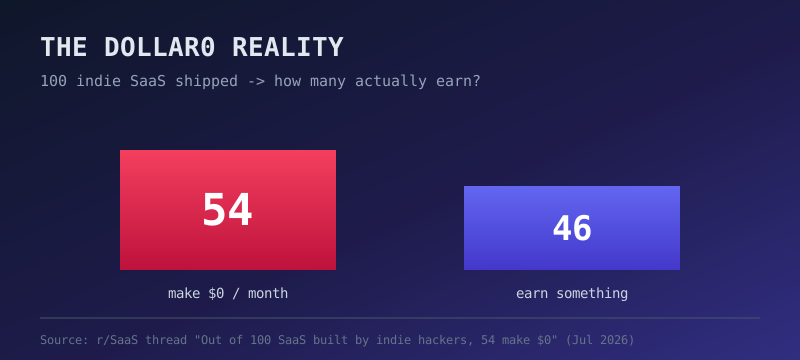
I was scrolling r/SaaS last night and a thread stopped me cold. The OP dropped one line: “Out of 100 SaaS built by indie hackers, on an average 54 MAKES $0.” Translation: of every 100 SaaS products indie hackers ship, 54 on average earn absolutely nothing per month.
The comments were even better than the post. One guy admitted he built 3 products, all at $0 revenue. Another posted his Stripe dashboard screenshot: 7 straight months, 0 transactions. I stared at that image for a while, then remembered the goal I set in January — “ship one profitable side project this year.” It’s July. The wallet is still silent.
So today we are not talking about getting rich. We are talking about the truth everyone avoids: shipping a SaaS is easy, making money is hard. Below are a few real cases — some that bled, some that print money quietly. Put together, they tell the real story.
1. What Kills the 54 That Make $0
I read through hundreds of replies on that thread. The $0 products basically die on three things:
- Nobody knows you exist. The common trait of most $0 SaaS: launch it on Product Hunt, then wait. Waited a month, organic traffic = 0. No SEO, no community presence, no cold outreach. It’s like opening a shop in the desert.
- Solving a problem only you have. Too many people write code before finding users. One r/SaaS regular came clean: his tool was built for himself, and after launch he realized he was the only person on earth who needed it. That product never had product-market fit, so it naturally lands in the 54.
- Too afraid to charge. This is the deadliest. Free tier is too generous, users leech and leave. Or payment is never wired up at all — tons of GitHub stars but $0 revenue. The reason isn’t “no users,” it’s “you never asked for money.”
Honestly, a big chunk of those 54 didn’t “fail.” They just never started selling.
2. The Quiet Winner: Pallyy at $85K/Month, Solo
In sharp contrast, there’s Pallyy — a case study reposted all over r/indiehackers. Founder Tim Bennetto taught himself to code, left his job as a locksmith in Melbourne, and built this social media management tool completely solo in 2019.
- Revenue: roughly $85,000/month, later hitting $1.2M in annual revenue
- Team: just 3 people, absurdly lean
- The edge: one “share analytics with others” feature, plus a laser focus on the social media agency niche
- Distribution: DMed social media managers and agencies on Instagram early on, ran a little Google/IG ads, hired a blog writer for SEO (he says this was the turning point for Pallyy), and launched an affiliate program
Notice he did no black magic. A boring social scheduling tool, rolled to $85K/month on SEO + tight niche + affiliates. That proves the money-making SaaS isn’t necessarily the smartest — it’s the one that nailed the “selling” part.
3. From Bankruptcy to $20K: The Directify Comeback
Another story I like is Directify. Founder Sergey had an agency that collapsed outright. Cash flow gone, but the person was fine. Instead of getting a job, he spent a few weeks on an MVP — a SaaS that helps people quickly build “directory / leaderboard” sites.
- Current state: about $20,000 in cumulative revenue
- Playbook: lifetime deals to get cash flow first, then shift to subscription
- Distribution: build in public on social, Product Hunt, Ahrefs keyword mining for content
What’s worth copying isn’t the tech — it’s the mindset. Main income collapsed, he didn’t panic, validated a cheap idea fast, and got the first dollar. $20K isn’t explosive, but it’s a restart from zero, done at side-project pace.
4. A 17-Year-Old Hit $3K in 6 Weeks
r/SideProject had a 17-year-old solo founder post that was also humbling. Launched in 2 weeks, crossed $3,000 revenue in 6 weeks, 44 paying users, built entirely alone.
- 6 weeks: $307 -> later pushed to $3K
- In the comments he said the real user driver wasn’t Product Hunt — it was showing up in relevant subreddits and answering questions honestly, mentioning his tool along the way
Young people have no baggage. They dare to “show their face” in communities. A lot of 30-year-old veterans are too proud to do that — ship the product and vanish, which is exactly how you end up in the 54.
5. The 54 vs The 46 — What’s the Difference?
Put the cases side by side and it’s obvious:
| Project | Monthly Rev | Main Channel | Common Trait |
|---|---|---|---|
| Pallyy | $85K | SEO + affiliates | nailed a niche, dared to charge |
| Directify | $20K cum. | build in public | got paid, then iterated |
| 17yo solo | $3K (6 wks) | community replies | thick skin, always visible |
| 54 at $0 | $0 | basically none | ship and wait, afraid to sell |
The gap isn’t coding skill. It’s whether you treat selling as seriously as building. None of the 46 winners sat around waiting for pie to fall from the sky.
6. If You’re Stuck at $0
If your product is sitting in those 54, don’t rush to build another one. Ask yourself three questions:
- Have I shown up consistently in where my users hang out for more than 30 days?
- Does my product have one “you’d be stupid not to pay” moment?
- Did I actively send out an invoice last month?
All “no”? You didn’t fail — you just haven’t started “doing business” yet. SaaS stands for Software as a Service, but the money comes from the second S: Service — serving real people, not talking to a screen alone.
Tomorrow I’m going to take that 3-month-old tool sitting at $0, wire up payments, and send a cold email sequence. If it dies, let it die on “rejected,” not on “nobody knew.”
- r/SaaS — “Out of 100 SaaS built by indie hackers, on an average 54 MAKES $0” (Jul 2026)
- r/indiehackers — Pallyy case study ($85K MRR, solo founder Tim Bennetto)
- r/SideProject — 17yo solo founder, $3K revenue in 6 weeks
- Culture of Code podcast — Directify ($20K revenue after agency collapse)