Boring Niches Print Money: The Unsexy Micro-SaaS Categories With 70-90% Margins
Every “SaaS ideas” list on the internet screams the same word: AI. Meanwhile a quieter crowd of solo founders is printing real money building software so unsexy you’d scroll right past it. No virality, no hype — just boring problems businesses pay for every single month. This is the micro-SaaS done the unglamorous way, and the margins are honestly better than the flashy stuff.
I pulled data from FlowJam’s 12 validated niches and Redwerk’s micro-SaaS margin breakdown. The pattern is consistent: the less exciting the problem, the stickier the revenue.
1. The Margin Leaderboard (Real Numbers)
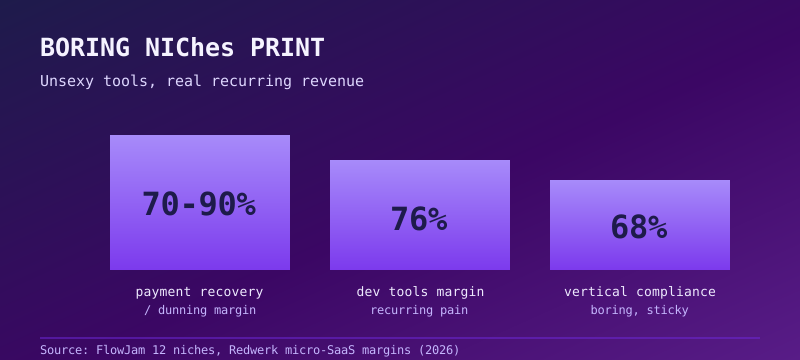
By gross margin, the highest-profit micro-SaaS categories in 2026:
| Category | Margin | Why It’s Boring (and Sticky) |
|---|---|---|
| Payment recovery / dunning | 70–90% | Recovers failed charges automatically; nobody notices it works until it saves them money |
| Dev tools | 76% | Engineers pay instantly for things that save them an hour |
| Vertical compliance | 68% | Boring legal/regulatory checklists; switching cost is huge |
| AI workflow automation | 65% | Hot, but the boring integrations win, not the demos |
| B2B integrations | 62% | “Make X talk to Y” — unglamorous, mission-critical |
Notice none of these are consumer apps or viral toys. They’re infrastructure other businesses quietly depend on. That’s the whole game.
2. Why Boring Wins
The single factor that predicts success isn’t how clever the idea is. It’s whether it solves a real, recurring, painful problem for a specific niche. Founders fail when they build something they think is cool. Boring-niche founders win because:
- Less competition. Nobody fights over “failed payment recovery for gym SaaS.” That’s exactly why the margin stays high.
- Recurring pain. Compliance doesn’t go away next quarter. Dunning doesn’t stop being a problem. The need is permanent.
- Willingness to pay. A business losing 15% of revenue to failed payments will gladly pay 2% to fix it. That’s an easy yes.
3. Three Boring Ideas With Real Comparables
From the idea lists, a few that anchor to real shipped products:
a) Failed-payment recovery for a vertical
- Pain: Stripe silently loses 10–15% of subscriptions to expired cards
- Comparable revenue: established dunning tools charge 0.5–2% of recovered revenue; at $50K/mo recovered that’s real money
- Build difficulty: low (Stripe webhooks + email retries)
- Validate in 30 days: post in a niche subreddit, offer to recover one month free
b) A niche job board with 3 revenue streams
- Pain: general boards are noise; a vertical board is signal
- Revenue: job posts (one-time) + featured listings (recurring) + resume DB access (sub)
- Build difficulty: low (WordPress or a tiny app)
- The moat: you own the community, competitors don’t
c) Internal-tool-as-a-service for one industry
- Pain: a repetitive back-office task done in 12 spreadsheets
- Comparable: vertical SaaS in compliance/ops routinely hit 68% margins
- Build difficulty: medium, but the switching cost locks users in
4. The $79/Month Opening
One pattern from the builder community: the $79/month price point leaves SMB markets wide open. Enterprise tools charge $500+. Consumer tools charge $9. The $79 SMB slot is underserved — expensive enough to filter tire-kickers, cheap enough for a business to swipe a card without a meeting.
If your boring tool saves a business more than $79/month (almost any real pain does), the price is a non-decision.
5. How to Find Your Boring Niche
Alex Berman (5 companies built and sold) frames it as mining communities for problems people already pay to solve:
- Pick an industry you have experience in — that’s your unfair advantage
- Read its subreddit / forum for “how do you guys handle X?” threads
- If people reply with duct-tape workarounds, that’s your product
- Spot ideas trailing behind new platform growth curves (new platform = new pain)
Your industry experience is worth more than any AI wrapper. The person who ran a gym knows gym billing pain intimately. The person who did medical billing knows that vertical cold. Outsiders build toys; insiders build tools.
6. The Unsexy Daily Test
Before you build, run the boring test:
- Would a business pay for this every month without a demo call? → good
- Is the problem permanent, not a trend? → good
- Would you be embarrassed to tell a VC about it? → even better
If all three check out, you’ve probably found a real business. The flashy AI demo gets the tweets. The boring dunning tool gets the Stripe payout.
- FlowJam — “12 Boring Niches That Print Money” (2026 margin data)
- Redwerk — “Micro SaaS Ideas That Actually Print Money” (2026)
- Ideaproof — “50 Micro-SaaS Ideas for Solo Founders” (cost, revenue, stack)
- Alex Berman (YouTube) — finding ideas with buyers attached, $79/mo SMB opening