From 75K to 340K a Year: The Real Books Behind Selling AI Automation in 2026
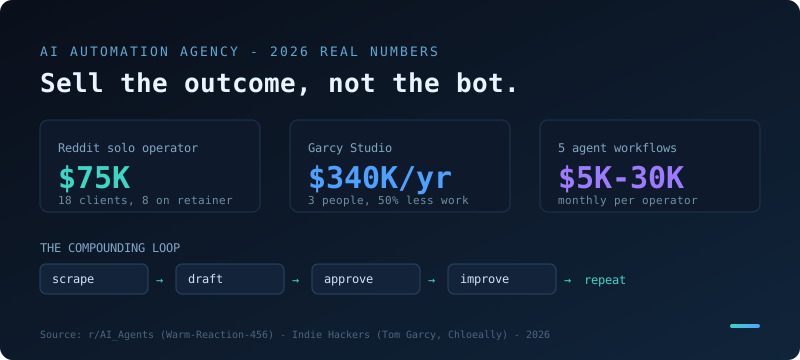
I spent a week buried in r/AI_Agents, Indie Hackers, and a few founder interviews trying to answer one question: in 2026, is selling “AI automation services” actually making money, or is it just another round of course-marketing smoke? Here’s the short version — some people are cashing real checks, and the numbers aren’t ugly. But how they make it is nothing like what you’d guess. Three cases below, all from people with their actual books open. Nobody’s selling a course.
—
## 1. One Reddit user’s 75K ledger
User Warm-Reaction-456 posted a long thread on r/AI_Agents with a blunt title: “I made 75K selling AI automations to clients. Here’s what I’d change if I started over.” He was doing GTM (go-to-market) freelance work for SaaS founders when one client asked him to “set up some AI thing” to handle lead follow-ups. He built it over a weekend with Zapier and GPT, taking the client’s average first-response time from 14 hours down to under 3 minutes. First quote: 2,500 dollars.
That was roughly a year ago. Since then he’s done 75K in revenue — not from tech giants, but from dental offices, HVAC companies, real estate teams, and insurance brokers: “businesses drowning in manual follow-ups and appointment scheduling with zero internal tech talent.”
**Core numbers:**
– about 18 clients total, average project just under 4,200 dollars
– 8 of them on monthly retainers, 3 stayed 8+ months
– referrals from old clients brought another 11K he didn’t have to sell for
– now 60% of revenue is retainer, 40% new builds
His mistakes are the useful part. Early on he quoted flat fees — a 12-hour lead-routing build and a 40-hour build sold for the same price. The first client got a steal; on the second he was earning minimum wage. He switched to “build fee 3,000 to 7,000 dollars plus monthly retainer 500 to 1,500 dollars.” The retainer is what turns project work into a business: APIs update silently, rate limits shift, a renamed form field breaks the whole flow. When a client’s leads stop flowing at 2am, he fixes it before they wake up. That peace of mind is worth more than the invoice.
**The line he wants you to remember:**
> Don’t sell AI, sell the outcome. Not one client asked what model I’m running or whether I’m on n8n, Make, or Zapier. They want to know how fast their leads get a reply, how many hours their team saves a week, and whether their follow-up rate goes up.
He deliberately targets “boring businesses” — ones that don’t comparison-shop and don’t ask for an architecture diagram. They just want the pain gone.
*Source: Reddit r/AI_Agents — “I made 75K selling AI automations to clients” (Warm-Reaction-456, 2026)*
—
## 2. Garcy Studio: 3 people, 340K a year, half the workload
Tom Garcy’s Indie Hackers interview is the one that stings. His design studio, Garcy Studio, does 340K a year (about 37K a month) with a core team of just 3 people, plus per-project specialists. And — over two years he cut both team size and workload by 50% while revenue held flat. The result: two to three times the money per project hour.
AI handles the unglamorous stuff — back-office admin, client management, task management, project management. The time he frees up goes into the actual work. His acquisition channel is even plainer: 99% word of mouth, with the occasional LinkedIn post and a couple of project newsletters.
**Two counterintuitive moves:**
– **One A+ person over three B-level people.** The expensive one gets it right the first time, needs almost no management, and saves a fortune long-term.
– **Monthly fees, not one-time charges.** Start with a project fee, then shift to a monthly retainer — some intensive branding projects even bill weekly. Clients get used to the monthly, and switching cost climbs. Not because you trap them, but because “replacing the person who knows where every wire connects” hurts more than the fee.
He’s now productizing his internal AI stack (a client knowledge base with agent memory) to sell outward, pushing toward “a day’s work in what used to take two weeks.”
*Source: Indie Hackers — “Maintaining 340k/yr revenue while halving agency workload” (Tom Garcy, Apr 2026)*
—
## 3. Five agent workflows that are actually running
Indie Hackers writer Chloeally dug across five platforms (Instagram, TikTok, Reddit, X, YouTube) and kept only workflows with real, documented income. Five stood out, each putting real monthly revenue in the operator’s pocket:
**Monthly revenue ranges:**
– **AI ghostwriting agency** — X and LinkedIn, 5,000 to 20,000 dollars/month. One operator runs 12 clients at 1,500 dollars/month; the agent does 90% of the work, he spends ~3 hours a week reviewing.
– **Faceless YouTube automation** — 2,000 to 30,000 dollars/month. Documented case “Bloo” hit 700M+ views and earned 1M+ dollars in ads and sponsorships.
– **Instagram DM lead gen** — 3,000 to 15,000 dollars/month. The agent sends 200 personalized DMs a day while he sleeps; close rate went up, not down.
– **TikTok affiliate and product research** — 1,000 to 8,000 dollars/month. Products trend and die in 2-3 weeks; a human can’t watch hundreds at once, an agent can.
– **Reddit intent mining to SaaS leads** — 2,000 to 10,000 dollars/month in pipeline value. Monitor 15-20 subreddits, treat “looking for a tool” posts as hot leads, close 30% of those reached.
Watch the top comment under the ghostwriting section: the numbers look real, but the missed bottleneck is that the agent generates content while the distribution system is what earns the fee. Clients don’t pay for drafts — they pay for output that actually reaches an audience. The operations that hold up own the pipeline end to end: research, draft, schedule, post, monitor.
*Source: Indie Hackers — “5 AI Agent Workflows Actually Making Money in 2026” (Chloeally, Apr 2026)*
—
## The pattern: it’s not the bot, it’s the compounding
Stack all three cases and the survivors of 2026 share one logic:
**Pattern 1: Sell the outcome, not the tech.** Clients want “leads get a personalized reply in 90 seconds, 24/7” — not “a GPT-powered multi-step automation workflow.” Say the latter and their eyes glaze over.
**Pattern 2: The monthly retainer is the moat.** A one-time build makes you a freelancer. Build fee plus retainer makes you a line item in the client’s monthly budget. Recurring share was 60% in case one and “almost all” in case two.
**Pattern 3: Agent value compounds, it doesn’t shine in one session.** The ghostwriting agent learns the client’s voice over months; the YouTube agent learns what topics pop; the Instagram agent learns which signals predict conversion. A single session isn’t impressive — hundreds of sessions accumulating “better” is. Gartner estimates 40% of agentic AI projects get abandoned by 2027. The ones left standing are built on compounding intelligence.
**Pattern 4: Pick boring businesses.** Dentists, HVAC, real estate, insurance. They don’t comparison-shop, don’t grill you on architecture, just want the pain gone. There’s no “will AI take my job” anxiety client here — only the grateful one whose 10 manual hours a week you deleted.
—
• Reddit r/AI_Agents — “I made 75K selling AI automations to clients. Here is what I would change” (Warm-Reaction-456, 2026)
• Indie Hackers — “Maintaining 340k/yr revenue while halving agency workload and headcount” (Tom Garcy, Apr 21 2026)
• Indie Hackers — “5 AI Agent Workflows Actually Making Money in 2026 (With Real Numbers)” (Chloeally, Apr 15 2026)
• Gartner estimate: 40% of agentic AI projects abandoned by 2027